
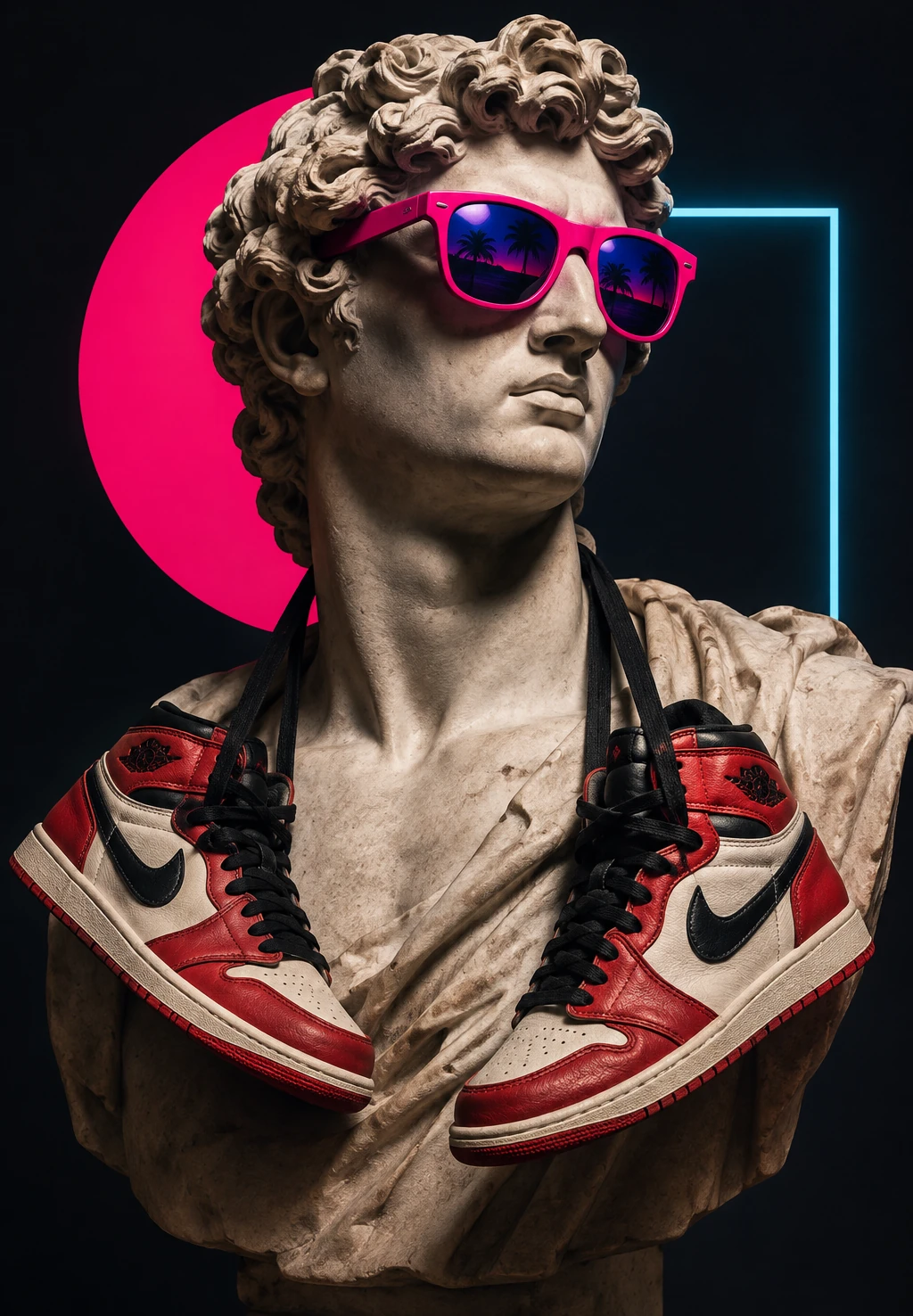
Have you ever wondered what happens when a pricey communications agency has to invent the name for a new brand? The scene is almost always the same: a six-hour meeting in a studio with plasterboard walls and glass whiteboards; tables buried under cups of cold coffee; a team of twenty-somethings with performance anxiety reeling off French words slapped together at random: «Boutique. Avant-garde. Je ne sais quoi.»; and finally, around seven in the evening, the exhausted creative director opens a dictionary of classical mythology and says: «Guys, let’s go with a Greek name. It reads as learned, it reads as ancient, nobody owns the copyright, and it suggests eternity.»
Why so many brands have Greek names
A free, elegant mine with no heirs claiming royalties. With one small flaw.
There is only one problem with this idyllic naming strategy: advertising creatives do not read the classics. Or, if they do, they probably stop at the three-line summary found on Wikipedia.
The result of this philological laziness is an exhilarating and unsettling catalogue of commercial short circuits. Trying to ennoble trainers, charm bracelets, luxury handbags and condoms, modern marketing has unwittingly titled its products after hallucinatory tragedies, gods of pickpockets, devastating women and the colossal defensive failures of antiquity. Today we take a trip through mythological naming, and find out why some of the most famous companies on the planet are selling you products that might as well be wishing catastrophe upon you.
Why Trojan condoms are called that
The brand that promises protection carries the name of the most famous security breach in history.
Let’s start with the absolute masterpiece of commercial counter-narrative. If you happen to travel in the United States and walk into any pharmacy, you will notice that the condom market is dominated by one historic and hugely widespread brand: Trojan. The logo shows off the plumed helmet of a classical warrior and conveys an idea of strength, protection, resistance and invulnerability.
Now, stop for a second and switch on your historical brain. What is «Trojan»? It is the English adjective for the city of Troy. And what is the one single devastating event for which Troy passed into the universal history of humankind? Being completely destroyed because its defences were penetrated from the inside.
Let’s replay the logistics. The Trojans have impregnable walls. For ten years the Achaeans cannot get in. Then Odysseus invents a rigid wooden shell, the horse. With unprecedented strategic short-sightedness, the Trojans take this shell, carry it inside the defensive perimeter of the city, and in the dead of night dozens of armed men climb out of it, break through the defences, slaughter the population and burn everything (Virgil, Aeneid, book II)12.
Now: what is the one fundamental job of a condom? The only reason you spend money to buy one? To stop a rigid shell from introducing an unexpected intruder inside the protected perimeter, causing a breach of the barriers and the resulting unplanned demographic explosion.
Calling a condom «Trojan» is the worst naming decision in the history of capitalism. It is the exact logical equivalent of:
- founding a cruise company and calling it Titanic;
- opening a scheduled airline and naming it Icarus Airways;
- selling an antivirus and calling it HackerGate, which computing has duly done, calling trojan horse the malware that hides inside harmless programs.
At this point the attentive reader will already be thinking: the logo is a helmet, not a horse; the brand refers to the Trojan warrior, not to the trick that defeated him. Quite true. And it has to be granted that the Trojans knew a thing or two about defending themselves: their walls held for ten years, a record no other siege of antiquity can claim.
This is exactly where the trap snaps shut. Because when you choose a defender as your figurehead, the customer does not remember the ten years it held: they remember the night it fell. Troy did not go down in history for the solidity of its walls, but for the one time they failed, and for how it happened. A defender famous exclusively for its final defeat is a dreadful guarantor.
Every time someone buys a pack of Trojans they are basically saying to their love life: «Timeo Danaos et dona ferentes». If the marketing department had read the second book of the Aeneid, the brand would probably be called «Theban Walls» or «Shield of Achilles». But history decided that the best-selling condom in the United States should carry the name of the most famous security hole in humanity.
Who the goddess Nike was, and why the brand bears her name
A winged deity who never ran a race in her life, now under the soles of half the world.
In the Sixties, when Phil Knight founded Blue Ribbon Sports, he soon understood that a punchier name was needed to compete in the athletic footwear market. In 1971 one of the company’s employees, Jeff Johnson, said he had dreamed of the Greek goddess of victory, Nike (Νίκη), and the name was adopted on the spot.
What the Swoosh really means
In the same year the graphic design student Carolyn Davidson drew the famous swoosh for the modest sum of thirty-five dollars. Reading the mark as the wing of the goddess, though, came later and belongs to the company’s own story: Davidson spoke rather of a shape that gave the idea of movement. The wing arrived afterwards, when a story was needed to live up to the name.
But who was Nike really, in the Greek pantheon? According to Hesiod (Theogony, 383-385)3 she is the daughter of the Titan Pallas and the nymph Styx. Together with her brothers Kratos, Power, Bia, Force, and Zelos, Emulation, she is among the first deities to side with Zeus in the war against the Titans. As a reward for her loyalty, Zeus keeps her permanently beside his throne.
In Greek iconography, of which the Winged Victory of Samothrace in the Louvre is the absolute masterpiece, Nike is not an athlete. She does not run marathons, does not lift weights, does not suffer from Achilles tendonitis and does not sweat on five-a-side pitches. She is a winged, bodiless deity who flies above blood-soaked battlefields to set a laurel crown on the head of the winner.
The wings, though, were not compulsory. In the temple of Athena Nike, on the south-west bastion of the Acropolis, the cult statue had none: it was a Nike apteros, wingless, and Pausanias (Description of Greece, I 22.4)4 reports the reason. The Athenians wanted her that way so that victory could never fly away from the city. For those who truly imagined the goddess, in short, the problem was not making her run: it was holding her, stopping her.
The irony here is not catastrophic as it is with Trojan: it is a sublimation of the profane. A martial and ethereal deity, whose only role was to decree the military triumph sanctioned by the gods, has been torn from the skies of Olympus and printed on the vulcanised rubber soles of millions of people who run in the park on Sunday morning complaining about a torn meniscus. If the goddess Nike saw what her name is paired with today, she would do exactly what the Athenians wanted to prevent: fly away. Except that they had already taken her wings off, to keep her from running away. Either way, it is a symbol of victory, a good omen for athletes, if we don’t want to be pedantic about it.
The myth of Pandora and the jar: what lies behind the jewellery name
Gifting the container of all the world’s evils, with modular charms.
If there is one brand that has built a global empire on selling modular bracelets, silver beads and charms for birthdays and anniversaries, it is Pandora. The concept is brilliant: you give the base bracelet and then, on every occasion, add a charm that stands for a memory, a feeling, a milestone in life. A romantic, reassuring, deeply affectionate idea.
Except that the story of Pandora is literally the narrative of the first great tragedy of humankind.
Hesiod comes to our help again, telling the myth both in the Theogony (570-612) and in the Works and Days (60-105)5. When Prometheus steals fire from the gods to give it to men, Zeus devises a terrible and sophisticated punishment: he orders Hephaestus to fashion a beautiful maiden out of earth and water. Every god gives her a gift. Aphrodite gives her grace and desire, Athena teaches her weaving, Hermes fills her with a lying soul and an insatiable curiosity. This is why she is called Pandora, which in Greek means «all the gifts».
Was it a jar or a box? Erasmus’s translation error
Zeus sends her to Earth as a bride for Epimetheus, the foolish brother of Prometheus, the one who thinks afterwards. Pandora brings with her a large sealed jar, the pithos. In 1508 Erasmus of Rotterdam, telling the myth in Latin, rendered pithos as pyxis, which means box: from there came the «box» of the modern languages and, by a roundabout route, our «jar». She had been strictly forbidden to open it. But the curiosity instilled by Hermes wins out: Pandora lifts the lid and releases into the world all evils, diseases, wars, sufferings and death, which until then humankind had never known.
Terrified, she closes the container again, leaving only Elpis, Hope, stuck at the bottom. Whether that Hope left inside is a comfort spared to mankind or the last of the evils, the one that deceives us and keeps us standing while everything collapses, is one of the longest arguments in classical philology: Hesiod does not say, and in 2,700 years nobody has settled it.
Now imagine the scene from the point of view of affectionate marketing. You offer your partner a piece of jewellery with the Pandora logo. From a philological point of view you are giving her the incarnation of the cursed deception devised by Zeus to destroy human happiness, a casket containing plague, envy and ruin. «Here you are, darling, a little bead to remind you of the day my life turned into a jar of sorrows.» A masterpiece of involuntary romance.
Who Hermes was, the god of merchants and thieves
The house is named after the founder. But the founder was named after him.
Let’s move into the world of unbridled luxury, where waiting lists for a handbag last for years and prices reach figures with four or five zeros. We are talking about Hermès, the French fashion house founded in 1837 by Thierry Hermès.
Of course, here the name comes from the real surname of the founder. And yet, for anyone with the slightest smattering of classical culture, it is impossible to detach the brand from the figure of the god Hermes (Ἑρμῆς), the winged messenger with the caduceus and the golden sandals. And that is where a very subtle, delicious socio-economic irony kicks in.
According to the Homeric Hymn to Hermes (Hymn IV), one of the funniest texts6 of antiquity, the god is born in the morning inside a cave on Mount Cyllene. At midday he climbs out of his cradle, finds a tortoise, kills it, empties the shell and invents the first lyre. In the late afternoon, still in swaddling bands, he slips away in secret and steals fifty divine cows from the pasture of his brother Apollo, hiding their tracks and walking them backwards to confuse anyone following.
When Apollo finds out and threatens him, the little Hermes goes back to his cradle, wraps himself in his swaddling bands again and swears with the cheek of a career politician that he does not even know what a cow is. Hermes is, by theological definition, the god of merchants, of borders, of travellers, of liars and of cattle thieves, as well as the Psychopomp who accompanies the souls of the dead into the afterlife.
Think about it. A house that sells a calfskin handbag for the price of a small car carries the name of the patron god of merchants and, in the very same list, of thieves. The ancients saw no contradiction in it: commerce and theft were two versions of the same skill, that of making things change hands by convincing someone it is a good idea. Hard to find a tutelary deity better suited to haute couture, and I suspect he would have enjoyed it enormously.
Amazon, ASUS, Starbucks: other names taken from myth
Three quick cases, in rising order of involuntariness.
From Pegasus to ASUS: the cut name
The Taiwanese computer company ASUS owes its name to Pegasus (Πήγασος), the winged horse born from the severed neck of the gorgon Medusa when Perseus cut off her head. So why ASUS and not PEGASUS? Simple: the founders removed the first three letters to sit better in catalogues and alphabetical listings. Cutting the front off the name of a winged horse born from a beheading is commercial meta-surgery worthy of a tragic hero.
The Starbucks siren is not a Greek siren
The logo of the most famous coffee chain in the world shows a two-tailed siren, technically a melusine. And here the mistake runs deeper than it seems, because the Sirens of Homer (Odyssey, book XII)7 have no fish tails: they are bird-women, creatures with the body of a bird and the face of a girl, and they kill with their voice from a meadow strewn with bones, not from the sea. The scaly tail is a medieval invention, arriving centuries later through contamination with the water creatures of northern folklore.
Starbucks has therefore put a Germanic figure on its sign perhaps believing it was quoting Greece, which in its own way is perfect: it bewitches you with the vanilla scent of a seasonal concoction topped with whipped cream and dashes your wallet against the rock of a seven-euro receipt for a long coffee. Exactly like the original, without ever having read it.
Why Amazon is called Amazon
Jeff Bezos chose the name in 1994 because he wanted the company to start with the letter A, to appear at the top of the alphabetical listings of the web, and because it recalled the Amazon, the largest river in the world. The Amazons (Ἀμαζόνες), however, were in Greek mythology the fierce tribe of warrior women who fought against Heracles and Theseus, known in popular tradition, however false the etymology, for cutting off their right breast to draw the bow better (a-mazos, without breast).
A multinational that ships parcels at the pace of a military battalion bears the name of ruthless warriors who hated the patriarchy.
The name of the river, by the way, comes from them: Francisco de Orellana baptised it in 1542, claiming he had been attacked by warrior women on its banks. The largest company in the world is therefore named after a legendary tribe, by way of a river named by a conquistador on the basis of testimony nobody has ever been able to verify. Three degrees of separation from the myth, and not one of them intended.
How to choose a mythological name well
Three rules, for anyone really looking for a name.
What does this surreal journey among the logos of our daily life teach us? That classical mythology is a goldmine for marketing: it is free, it is elegant, it has an archaic flavour and it conveys an immediate sense of prestige.
It also teaches us that myth is not a bedtime story that can be summed up in a three-word slogan. It is a complex, ruthless system, full of blood, betrayals, divine vendettas and cosmic punishments. If you really must fish in it, three precautions:
- Read the story to the last chapter, not the first half. Almost all the disastrous names in this article come from myths that start beautifully.
- Ask yourself what that character is famous for, not what it was capable of. Troy had the best walls in the Mediterranean and is remembered for the day they fell.
- Distrust names that describe your weak point. A defeated defender on a condom, a jar of calamities on a gift jewel, a temptress who wrecks those who listen to her on a coffee chain: in all three cases the myth tells exactly what the customer is afraid will happen.
Otherwise the risk is just around the corner: you could found a marriage counselling agency and call it Medea, open a life insurance company and name it Oedipus, or launch a personal finance app named after King Midas, forgetting that the unfortunate sovereign ended up starving to death because even the bread he touched turned into gold.
The next time you go shopping, look at the logos on your shoes, on your jewellery or in your wallet. Smile at the gods of Olympus watching you from the shop windows, and remember that modern marketing thinks it invented persuasion, while the Greeks had already understood everything three thousand years ago. Above all how to run an excellent scam with a wooden horse.
A due final admission: whoever writes this also makes part of their living from Greek mythology printed on objects. The difference, one hopes, is that before printing the story I read it to the end. Which, as you will have gathered, does not guarantee choosing any better: it only guarantees knowing, in part, what one is doing.
Quick questions
Why is Nike named after the Greek goddess? In 1971 an employee, Jeff Johnson, proposed the name after dreaming of her. Nike was the winged deity of victory, daughter of Pallas and Styx, companion of the throne of Zeus.
Why does the Nike of the Acropolis have no wings? Because the Athenians wanted victory to stay in the city. The cult statue of the temple of Athena Nike was apteros, wingless: Pausanias tells it in the Description of Greece.
What was in Pandora’s jar? All evils, according to Hesiod. Only Elpis, hope, remained at the bottom, and it has been debated ever since whether it was a comfort or the last of the evils.
Does the name Trojan refer to the horse? No, to the Trojan warrior, chosen as a symbol of strength. The problem is that Troy is famous for how that warrior ended.
Does Amazon take its name from the Amazons? Indirectly: from the river, which Francisco de Orellana named in 1542 saying he had been attacked by warrior women.
Is the Starbucks siren Greek? No. It is a two-tailed melusine, a medieval northern European figure. The Sirens of Homer were bird-women.