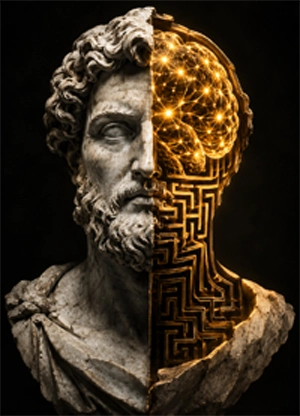
We tend to think of keyboard warriors, social-media troublemakers, and negative TripAdvisor reviews as exclusive by-products of the modern age: a deviation born with Web 2.0 and free Wi-Fi. We like to imagine that gratuitous cynicism is a child of our times. But the ancient Greeks, with their uncanny talent for dissecting the human psyche, had already identified, catalogued, and even deified this very concept thousands of years ago.
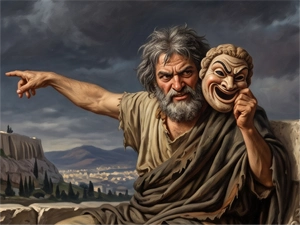
Long before internet trolls, comedy roasts, Twitter rows, and fights in Facebook comments, there was Momus. He was the divine personification of mockery, ridicule, savage satire, and, above all, unsolicited criticism. If Olympus had been an online forum, Momus would have been the user with the anonymous avatar who spends his days taking apart other people’s arguments, pointing out typos, and reminding everyone just how irredeemably flawed their lives are.
This minor deity, unlike much more illustrious colleagues who dealt with lightning, wars or tidal waves, specialized in a much more exhausting discipline: pointing out the defects of everything and everyone. Not even the powerful and touchy gods of the Greek pantheon were safe from his sharp tongue.
A nightmare family tree: the origins of “momismo”
To understand Momus, we need to look at his family tree. According to Hesiod’s Theogony1, he was not born from a ray of sunshine or the foam of the sea. He is the son of Nyx, Night, who gave birth to him alone, without male intervention, through parthenogenesis. This mythological detail is no accident: the fiercest criticism, gnawing doubt, and blame arise in the heart of the night, in moments of darkness and introspection when the certainties of daylight crumble.
Momus is the brother of entities that are anything but reassuring: Moros (ineluctable Destiny), Thanatos (Death), Oizys (Misery), Apate (Deception) and Eris (Discord). In short, the typical family you would never want to spend Christmas lunch with. Growing up in this cheerful and carefree environment, it is not surprising that his only pastime was destroying other people’s self-esteem.
His name comes from the Greek Μῶμος (Momos), a term closely associated with reproach, moral censure, and an obsessive search for flaws. The same root also gives us the Italian word momismo, a term still used today, albeit rarely, for systematic, sterile, malicious criticism. Dropping it into conversation certainly sounds impressive. It describes the pathological habit of always finding something to complain about, even in a successful piece of work.
The first negative review format: the divine contest
The most famous myth in which he is the protagonist (handed down in various classical fragments and fables, including those of Aesop) tells of a bizarre competition announced by Zeus. The king of the gods, probably bored by the routine of Olympus, called together Poseidon, Athena and Prometheus (in some subsequent reworkings, the role of sculptor of humanity is associated with Hephaestus, or the Roman Vulcan, but the substance does not change). The challenge was to create the best work, and Momus was unwisely chosen as the supreme judge, or more likely he invited himself as an external critic.
The three gods got to work, producing true masterpieces, but Momus managed to find structural flaws in each of them.
The Bull of Poseidon
The god of the sea fashioned a magnificent bull, a symbol of strength and virility. Momus looked it over, shook his head, and rejected the design:
“Gorgeous, for heaven’s sake. But who is the engineer who put the horns on the sides of the head? You should have positioned them in the center, right under the eyes or on the forehead. As it is, when it charges with its head down, the animal absolutely cannot see where it is hitting. An unacceptable ergonomic error.”
The House of Athena
The goddess of wisdom presented a splendid home, perfectly proportioned, safe and welcoming. Momus wandered around the rooms, knocked on the walls and said:
“Lovely architecture, good materials. But why didn’t you put wheels under the foundation? If someone buys this wonderful house, but the neighbor turns out to be an unbearable idiot, how can he escape? Without wheels, the house is a death trap for patience.”
The Human Being of Prometheus
When it came to judging the creation of human beings, Momus’s cynicism really came into its own. He looked at the man, examined his anatomy, and sighed:
“Very nice. Walking on two legs certainly has its charm. But you’ve made a spectacular design mistake: you haven’t fitted any handy little doors in the chest. Without a window onto the heart, how are we supposed to read people’s hidden thoughts? How can we expose their hypocrisy or know whether the person facing us loves us or is plotting to stab us in the back? You’ve just created a species built on deception.”
The criticism of Prometheus’ work is, upon closer inspection, of a disarming philosophical depth: the opacity of the human mind, the impossibility of knowing the true intentions of others, is the basis of every social, literary and theatrical drama in the history of humanity.
The clinical case of Aphrodite and the noisy sandals
But the true masterpiece of momismo, the unsurpassed summit of divine nitpicking, came when it was Aphrodite’s turn to be judged. The goddess of love and beauty stepped up for inspection, and Momus faced his ultimate challenge. The risk of having to award a five-star review was dangerously high: an affront to his very existence.
He scrutinized her from head to toe, circling her like a tax inspector. He was desperately searching for a flaw, an asymmetry, an enlarged pore, a faulty proportion, or a single hair out of place that he could savage with his legendary pedantry. No luck. The goddess was absolute perfection, an unassailable masterpiece, the Platonic Ideal made flesh.
Anyone else, faced with such an aesthetic epiphany, would have raised their hands admitting defeat, capitulating in the face of the sublime. But not Momus. He was the god of blame, the founder of the controversialists’ union and the undisputed progenitor of all haters. Rather than give her the satisfaction of unconditional approval and to safeguard his reputation as a contrarian, he crouched on the ground, pricked up his ears and, turning up his nose with an expression of pure and sincere disgust, issued his sentence:
“Yes, all right, she’s beautiful. No arguing with that. The proportions are right, the skin glows, the symmetry checks out… but have you heard her walk? Her sandals make an unbearable noise. There’s this constant squeaking with every step. Squeak, squeak. Infuriating. It’s an unforgivable acoustic defect that destroys all the poetry of the encounter. Ruins the whole thing. Two out of ten.”
Faced with such a toxic and unattainable level of fussiness, the myth teaches us that the hater does not attack because the work is bad; he attacks because his nature requires him to never accept beauty without polluting it.
The permaban from Olympus: the fall of the troll
Obviously, you can’t troll the administrators of the server of reality forever without suffering the consequences. The Greek Olympus was, in fact, an enormous and dysfunctional “echo chamber”, a bubble in which narcissistic, vengeful and touchy divinities loved to be venerated and flattered, without contradiction.
Eventually, Momus’s perpetually argumentative attitude, his habit of bursting vanity bubbles, and his chronic inability to keep his mouth shut led him to cross the line of divine tolerance. He was officially “banned” (sorry, ignominiously kicked out) from Mount Olympus for being insufferable. Zeus threw him down to Earth, condemning him to exile among human beings.
Paradoxically, exile among mortals was Momus’s greatest success: humanity, with its hypocrisy, its flaws, its neuroses and its disproportionate ambitions, proved to be the perfect playground for the god of criticism.
The philosophy of dissent: from Lucian to Leon Battista Alberti
Still, let’s not make the mistake of dismissing Momus as nothing more than mythology’s “bad guy”, a pointless spoilsport. He is a remarkably complex figure who embodies the sharpest edge of human intelligence: critical thinking and systematic doubt. Across the centuries, he has been portrayed as the eternal opposition, the “jester of Olympus”, the only possible vaccine against the dictatorship of conformity.
Many classical and Renaissance writers returned to him precisely because of this social role. The Greek satirist Lucian of Samosata, for example, used him in his dialogues as a mouthpiece for exposing the hypocrisies of the religion and philosophy of his age.
But the most brilliant literary consecration came in the Renaissance, with Leon Battista Alberti, who in 1450 wrote an entire satirical novel entitled Momus. In Alberti’s work, Momus becomes the dissident philosopher, the inconvenient intellectual who, with his sarcasm, exposes corruption, the absurdities of human politics and the tyranny of the powerful. Momus becomes the voice of truth that power does not want to listen to, demonstrating that “momismo”, if channeled correctly, is the main tool of civil satire.
The Archetype of the Jester and the Fool of the Tarot
Just as the court jester in the Middle Ages and Renaissance was historically the only figure within the palace who was granted the privilege of telling the inconvenient truth or openly mocking the king without risking immediate decapitation, Momus did the exact same thing with the infallible Olympian deities. The jester is not part of the hierarchy: he is outside it, and for this very reason he can judge it.
It is no coincidence that, in the esoteric and psychological fields, Momus is sometimes compared to the figure of the Fool in tarot cards (the Arcanum number Zero or, in some decks, the number XXII). Even if there is no certain historical and documented line that allows us to trace a direct lineage from the Greek divinity to this specific card (the tarot was born in a very different medieval and Renaissance context), the connection is very powerful on a symbolic, Jungian and iconographic level.
The Fool in tarot embodies that very archetype: the outsider, the creative disruption, the anarchist who steps beyond society’s rigid rules and established conventions. The Fool walks along the edge of a precipice without looking down, guided by a logic all his own. Like Momus, he has the complete freedom, and sometimes the sheer recklessness, to say aloud what everyone else keeps quiet out of fear, self-interest, or a desire for a peaceful life. Both embody the Shadow, the reverse side of the established order, needed to stop power and ego from becoming blind to their own limits.
Punching up: why Momus was a classy troll (and we aren’t)
There is, however, a fundamental distinction between the god Momus and the modern keyboard warrior that infests the comments under news articles or YouTube tutorials.
The golden rule of satire and criticism, what in Anglo-Saxon jargon is called punching up, establishes that one must always strike upwards (power, institutions, those who believe they are infallible, divinities) and never downwards (the weak, the marginalized, the victims of events).
Momus respected this rule perfectly. The god of mockery criticized the gods. He pointed the finger at the omnipotence of Zeus, the arrogance of Poseidon, the unassailable perfection of Aphrodite. He dismantled the egos of immortal beings who could zap him with a snap of their fingers. It was a calculated risk, a rebellion against the absolute.
There is nothing divine about the modern troll. He pounces on a grammatical error in a sincere declaration of love, spits out opinions about a stranger’s haircut, or, to borrow a fitting exaggeration, complains about the faded curtains while the house is on fire. Momus looked for flaws in perfection; the modern cynic, rather more sadly, looks for flaws in vulnerability.
And if the Olympian gods really do still exist somewhere, you can bet that Momus is watching our social-media arguments, shaking his head, and complaining that we’ve managed to ruin even the noble art of hating other people.
Notes
- Hesiod, Theogony 211-214. ↑