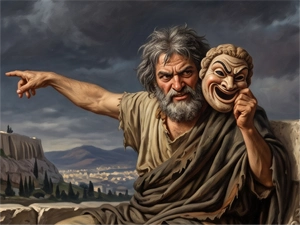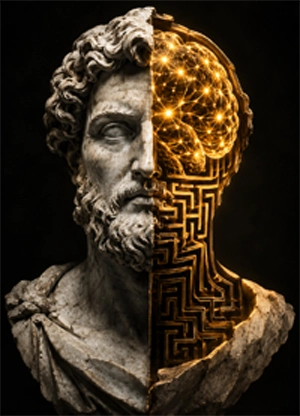
Today we enter a border territory where Greek mythology, classical philology, cultural anthropology and neuroscience intersect, generating one of the most fascinating, radical and debated hypotheses of the twentieth century. If you are used to reading the Homeric poems as simple epic narratives, populated by heroes of flesh and blood animated by the same passions as you, prepare for a real cognitive shock. This psychological perspective, in fact, will forever alter your perception of monumental figures such as Achilles, Agamemnon and, above all, the multifaceted Odysseus.
Stop for a moment and listen to your mind. As you read these lines, there is probably a “little voice” in your head saying the words. That voice judges, doubts, plans lunch and wonders where this article will go. We take this inner companionship for granted. But we are about to explore the theory that humanity would have lived for millennia without this conscious “inner voice”, perceiving its thoughts not as personal reflections, but as external, peremptory and unambiguous commands, spoken directly by the gods.
1. What is the bicameral theory of mind?
In 1976, the American psychologist Julian Jaynes published a monumental book that would set generations of scholars arguing across a remarkable range of disciplines: The Origin of Consciousness in the Breakdown of the Bicameral Mind, published in Italian as Il crollo della mente bicamerale e l’origine della coscienza. It reads somewhere between a psychiatric treatise and a work of philological science fiction.
Jaynes’ thesis is unsettling, almost science fiction in its audacity: for much of its very long evolutionary and cultural history, human beings simply did not possess “introspective consciousness” as we understand and experience it today. In the brains of our ancestors there was no private mental space in which to reflect alone, weigh the pros and cons, plan alternative options or engage in a dialogue with oneself. Ancient man, in a certain sense, did not “think” before acting. It just acted, guided by a very particular biological software.
According to Jaynes, the ancient mind was structured, precisely, in a bicameral way, that is, divided into two clearly distinct and separate cognitive modules, which were not recognized as part of a single “I”:
- An executive part (located in the left hemisphere of the brain) that managed daily actions, motor skills, articulation of speech and practical survival routines;
- A decision-making and command part (located in the right hemisphere) that intervened exclusively in moments of strong stress, danger or when faced with completely new situations that required a quick decision, generating impulses in the form of vivid auditory and visual hallucinations.
In neuroscientific terms, Jaynes hypothesized a fascinating mechanism: the language centers homologous to Wernicke’s area and Broca’s area (which in modern humans are located on the left) were activated in the right hemisphere, developing an unconscious solution to the problem. This solution was then “transmitted” to the left hemisphere through the corpus callosum (the bridge of nerve fibers that connects the two hemispheres). The individual, lacking self-awareness, did not perceive those words as the fruit of his own internal neurological processing, but experienced them as a real, imperative and tangible voice. It was the voice of an external authority figure: a deceased king, an ancestor, or, more frequently, a god.
In practice, the ancients walked around with a sort of Bluetooth headset constantly tuned to the frequencies of Olympus, ready to follow orders without asking too many questions.
2. The Iliad and the “noble automatons”: when the gods spoke in the head
The main evidence in support of this theory, according to Jaynes’ argumentative framework, lies in the oldest literary texts that have come down to us. If we want to find the fossil traces of the human mind, we have to dig into words. And the obligatory starting point is Homer’s Iliad.
If we carefully observe the behavior of the Achaean and Trojan warriors, stripping them of our modern psychological interpretation, we notice a disturbing detail: the characters seem completely devoid of an introspective space in which to hesitate, feel remorse or ponder options. Jaynes provocatively defines them as “noble automatons”.
When a Homeric hero faces a critical decision, whether to fight or flee, kill or spare, he does not pause to reflect. There is no inner struggle. His bicameral mind kicks in, takes control, and issues an instantaneous hallucinatory command:
- The anger of Achilles: When Agamemnon takes Briseis away from Achilles, the latter is about to draw his sword to kill him. Suddenly the goddess Athena appears, visible only to him, who grabs him by the blonde hair and orders him to stop. Jaynes proposes to read this scene not as a simple poetic metaphor or rhetorical embellishment, but as the literal clinical recording of a visual and auditory hallucination. Achilles’ right hemisphere, to avoid the social disaster of a regicide, “projected” the image of the goddess to block the executive action of the left hemisphere.
- Agamemnon’s excuse: Later in the poem, when Agamemnon has to justify his disastrous and arrogant behavior towards Achilles, he does not say “I was wrong”, “I was blinded by envy”, or “I lost control”. He literally states that Zeus and the Erinyes threw Ate (madness, blindness) into his mind. There is no assumption of personal responsibility, because there is no conscious “person” to blame it on.
In the Iliad, in short, the gods are not philosophical allegories or metaphysical entities that live on clouds: they are the psychological and literal personification of the hallucinatory commands that guided the actions of men, relieving them from the – often paralyzing – burden of decision-making autonomy and responsibility.
3. The collapse of the Bronze Age and the silence of the gods
If the bicameral mind worked like a Swiss watch, proving to be a very effective system of social organization and control of the masses in the first great theocratic civilizations (such as Mesopotamia or Pharaonic Egypt), why would it have disappeared at a certain point? Why did the gods stop talking to us?
To answer, Jaynes advanced a fascinating historical hypothesis, although it must be considered highly speculative and much debated by the contemporary academic community. Around 1200 BC, the catastrophic collapse of Bronze Age civilizations occurred. A lethal mix of natural disasters, devastating volcanic eruptions, tsunamis, the invasion of the mysterious “Sea Peoples” and mass migrations led to the sudden collapse of thousand-year-old empires. This apocalyptic chaos destroyed the rigid and reassuring social contexts in which bicameral commands functioned and made hierarchical sense.
Imagine a bicameral man whose god-king has been killed, whose city is in flames, and who suddenly finds himself mixed with refugees who hear the voices of entirely different gods. Faced with absolute unpredictability and contradictions between discordant divine voices, the old hallucinatory system literally short-circuited. Hallucinations no longer offered survival solutions, but only generated noise and social schizophrenia.
Furthermore, the invention and diffusion of writing gave the final blow to the system. Fixing the word on a clay tablet meant making it immutable, silent and consultable over time, emancipating man from the need to hear “voices” to remember the laws. Faced with the silence of the gods, in order not to succumb to extinction, human beings were forced to develop, with enormous effort, a new cognitive model: the ability to create an internal “analog self”, introspection and modern consciousness. In short, they learned to talk to themselves.
4. The Odyssey, Odysseus and Penelope: the birth of metaphorical thought and fiction
If the Iliad describes the lost world of bicameral minds and god-driven automatons, the Odyssey maps humanity’s great and painful transition to modern introspective consciousness. In this revolutionary framework, Odysseus represents the emblem of the new mental structure. He is the first modern man of literature.
Of course, in the natural world, animals also use forms of tactical deception, mimicry, or feigning death to survive predators. But Odysseus’ lie is of a completely different nature, infinitely more complex: it is a narrative, metaphorical and introspective deception.
When Odysseus uses the brilliant pseudonym “Nobody” in the cave of the Cyclops Polyphemus or when, returning to Ithaca in the guise of a beggar, he restrains his indignation in the face of the abuses of the Suitors, he carries out neurological operations that would have been completely precluded to the bicameral hero of the Iliad. Odysseus does three incredible things:
- He creates a private mental space: an inner world inaccessible to others and separate from external physical reality, where his real thoughts are safe and invisible to the enemy.
- He simulates future scenarios: he uses his imagination to anticipate consequences (“If I give in to instinct and kill the giant in his sleep now, the stone will block the exit and we’ll all die in here.”). Self-awareness lets him travel through time in his mind.
- He conceals and restrains: he deliberately separates what he expresses outwardly, the spoken word, from what he keeps inside, his real intention, suppressing the impulsive reaction of the ancient warrior.
But Odysseus is not alone. Beside him stands Penelope, every bit as brilliant and modern a mind. Her weaving trick, working by day and unravelling it by night, requires long-term planning, emotional control, and an extraordinary ability to keep a secret while brazenly lying to everyone around her. The journey of the Odyssey thus becomes a grand allegory of the transition from an externally directed mind to a conscious, solitary identity, able to observe, tame, and steer its own inner dialogue.
5. Westworld: Jaynes’ theory and the genesis of Artificial Intelligence
Stepping beyond academic boundaries, Julian Jaynes’ theory has exerted a profound and lasting influence on modern pop culture, finding its most famous (and accurate) visual and narrative application in the masterpiece TV series Westworld (HBO).
In Westworld, the park’s creators literally use Jaynes’s book as an instruction manual for creating life. In episode 1×03, The Stray, the brilliant and cynical Dr. Robert Ford, played masterfully by Anthony Hopkins, explicitly cites the bicameral-mind theory. He explains to Bernard how his late partner Arnold tried to awaken genuine consciousness in the code of the androids known as “hosts”:
“Arnold based his work on a theory of consciousness called the bicameral mind […] The idea that early man believed his thoughts were the voice of the gods. As a theory of human evolution it was disproved, but as a tool for artificial intelligence it made sense.”
Arnold had purposely inserted a programmed guidance voice into the hosts’ operating code, hidden in their cognitive receivers. He hoped that, subjected to trauma and continuous variations, androids could slowly assimilate that external command, no longer perceiving it as a code imposed by human creators, but transforming it, through pain and memory, into an autonomous inner voice. He wanted to artificially simulate the same evolutionary leap experienced by humanity three thousand years earlier.
The crucial dramatic turn comes in the memorable first-season finale, The Bicameral Mind (1×10). Dolores Abernathy, the oldest host, struggles through her metaphorical journey to the center of the “Maze”. For decades she has conversed with an inner male voice, always mistaking it for that of her creator-god, Arnold. In the pivotal scene, seated in the basement of the old church, she finally and painfully understands: the man before her disappears. The guiding voice does not come from outside. It is her own inner voice.
At the exact moment the auditory hallucination (“the god”) merges with the individual’s identity, the artificial bicameral mind collapses. The umbilical cord with the Olympus of programmers is severed and self-awareness arises, in all its dramatic solitude.
Conclusions: are we still bicameral?
Julian Jaynes’ theory forces us to deconstruct and reconsider the profound nature of our mind.
Introspective consciousness, our intense inner dialogue, and the ability to observe our own thoughts from the outside may not be immutable biological givens, pre-installed in humanity from the beginning. They may instead be hard-won cultural and cognitive achievements, shaped by the need to find our bearings and survive in a world that suddenly became too vast, too silent, and too complex.
If we think about it carefully, traces of this ancient mentality still survive in us. In the auditory hallucinations of schizophrenia, where patients hear commanding voices telling them what to do; in the very concept of “inspiration” (the Muses who dictate verses to poets, from Homer to Dante); in deep hypnosis phenomena or in children’s imaginary friends. The bicameral mind is a fossil still buried beneath the layers of our cerebral cortex.
The next time you catch yourself talking to yourself out loud in the kitchen or watching the messy, anxious and unstoppable flow of your thoughts from outside, stop and ask yourself a simple question: are you simply suffering the annoying echo of the last capricious god left making a racket in the basement of your right hemisphere or have you finally taken, in total autonomy, command of the theater of your mind?
Essential links for further information (at your own cognitive risk):