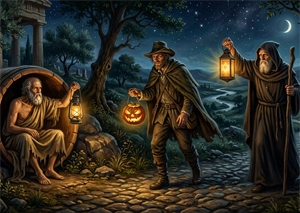
A perfect, cathartic conclusion, worthy of the great classic blockbuster. It’s just a shame that, for the ancient Greeks, things didn’t go that way at all.
If you think forced sequels, unsolicited reboots, and third-rate soap operas are an invention of modern network television, prepare to think again. In the 6th century BC, a poet called Eugammon of Cyrene decided that the Odyssey could not end in such a “quiet” way.
He picked up a reed pen, some parchment, and a generous helping of the macabre, and produced the Telegony (Τηλεγονία)1.
The result? A lost work, surviving through summaries, that turns the venerable saga of Homer’s hero into a cross between a reality show about dysfunctional people and a particularly chaotic episode of The Bold and the Beautiful.
Welcome to the “Marvel Cinematic Universe” of Ancient Greece: here is the true, disconcerting and irreverent end of Odysseus.
The epic cycle: when the canon became a franchise
To understand how a work like Telegony could be born, we must take a small step back to understand what the epic cycle was.
Homer did not work in a vacuum. Around his main works (the Iliad and the Odyssey) gravitated a galaxy of minor poets who tried to fill every single plot hole left by the Master.
Need the story of what happened before Achilles’ wrath? Here comes the Cypria. Want a detailed account of the fall of Troy? Enter the Iliou Persis.
In this panorama of a true franchise, Telegony represented the last piece in chronological order. It was the definitive ending, the word “END” printed in large letters on the life of Odysseus.
Unfortunately for us, or perhaps fortunately given the plot, Eugammon’s original text has been almost totally lost. What we know we owe mainly to the Chrestomathy of Proclus, a grammarian of the imperial age2 who took the trouble to summarize all these minor works for posterity. And it is precisely thanks to his notes that today we can reconstruct this pearl of mythological trash.
Meanwhile in Ithaca: Odysseus can’t sit still
The Odyssey has accustomed us to a desperate Odysseus who wants nothing more than to return home, embrace his wife, and grow old in peace. The Telegony promptly demolishes that romantic picture.
After slaughtering the suitors and burying the dead, Odysseus decides that Ithaca is already cramping his style. He travels to Elis to inspect his herds, then heads for Thesprotia in Epirus. Here comes the first twist guaranteed to make any reader of Homer fall off their chair: Odysseus marries the local queen, Callidice.
Yes, you read that correctly. While Penelope waits at home after twenty years of fidelity and nightly unravelling of her weaving, Odysseus starts another family. He leads his new wife’s army against their neighbors, fathers a son called Polypoetes, and stays until Callidice dies.
At that point, having handed over the kingdom to his son, the hero decides that it is time to return to Penelope as if nothing had happened.
But the real problem is not what Odysseus is doing in Thesprotia. The real problem is growing on another island, much further west: Aeaea, the kingdom of the sorceress Circe.
Telegonus: the son of Odysseus and Circe, with an unconventional weapon
During his famous stop at Circe’s (the one in which his companions are transformed into pigs), Odysseus did not limit himself to drinking wine and negotiating the release of the crew. From their union a child was born: Telegonus, whose name literally means “born far away”.
Raised under the watchful eye of an overprotective sorceress, Telegonus grows into a strong, curious young warrior. On coming of age, he asks Circe who his father is. She not only reveals the identity of the great king of Ithaca, but gives him a mission: set sail and meet him.
To make sure the boy does not travel unarmed, Circe gives him a very special spear. Not just any weapon: a spear forged by Hephaestus himself, tipped not with bronze or iron but with the venomous barb of a stingray (Trygon pastinaca, a ray equipped with a serrated, venomous spine).
A questionable stylistic choice, of course, but extremely effective if the goal is to cause damage.
The dramatic misunderstanding: when the robbery goes wrong
Telegonus embarks and sets course for Ithaca. When he finally sights land, the boy makes a huge mistake. He goes ashore, does not recognize the island (or perhaps mistakes it for a foreign land to be plundered, as was good practice for sailors of the time) and begins stealing livestock to feed his crew.
The farmers of Ithaca immediately run to their king screaming that a group of pirates is devastating the coasts.
Odysseus, now elderly but always ready for a fight, dons his armour, calls together his son Telemachus and rushes onto the beach to repel the invaders. On the shoreline he finds himself faced with this unknown young man holding a strange spear.
Neither of them knows who the other is. There is no time for introductions, there are no classic Homeric speeches on the lineage of the ancestors. The clash is immediate, blind and furious.
Telegonus strikes with his bizarre spear. Its venom-coated stingray barb grazes Odysseus’s skin. The hero of Troy, the man of many wiles who survived Polyphemus, Scylla, Charybdis, the Sirens, and Poseidon’s wrath, collapses in agony and dies from the fish’s venom.
Tiresias’ prophecy and the mockery of fate
In this tragicomic moment, one of the most famous and misunderstood prophecies of antiquity is fulfilled: the one that the soothsayer Tiresias had made to Odysseus during his descent into the Underworld, in Book XI of the Odyssey.
Tiresias had predicted to Odysseus:
“Death will come to you from the sea, a very gentle death, taking you when peaceful old age has worn you down…”3
For centuries, Odysseus had interpreted those words as thinking himself safe away from the waves or believing he would die peacefully in a seaside city. Instead, fate has a decidedly perverse sense of humor.
First, “from the sea” (ex halós)4: death literally arrived from the sea, in the form of a fish’s barb attached to a spear. Second, “very gentle”: well, stingray venom raises a few questions there, but the poetic tradition has had to bend over backwards to make the prophecy fit.
As Odysseus breathes his last, Telegonus approaches the fallen warrior’s body. A few words with the weeping Telemachus are enough to bring the whole scene crashing down: the killer discovers that he has just run his own father through.
Despair is total, but the worst is yet to come.
The soap opera ending: cross-marriages and immortality for all
If the story ended here, we would have a classic Greek tragedy built on recognition that comes too late and a fate no one can escape. But Eugammon of Cyrene decides that this is still not enough. Time to put the grotesque into overdrive.
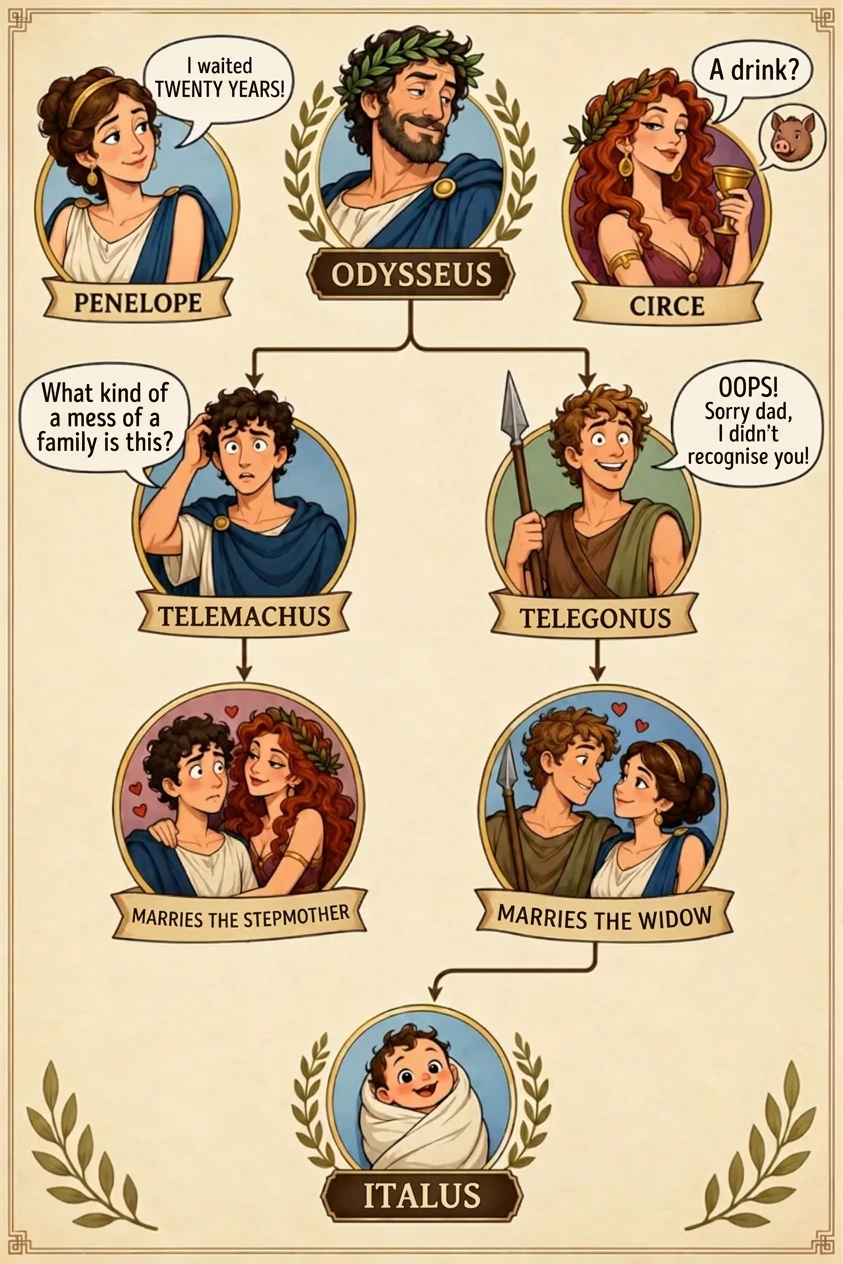
Devastated by remorse, Telegonus loads his father’s body onto his ship. But he does not leave alone: he persuades Penelope, the widow, and Telemachus, his half-brother and Odysseus’s legitimate son, to come with him. One big happy family, they set sail for Aeaea and Mother Circe, to give Odysseus a fitting burial.
Once they arrive on the island and celebrate the funeral, the plot takes a turn that would drive any modern psychotherapist crazy.
We are witnessing a cross-couple exchange that defies all ethical, biological and narrative logic:
- Telemachus marries Circe: the son of Odysseus marries the sorceress who years earlier had turned his father’s companions into pigs and who had been his lover.
- Telegonus marries Penelope: the murderer of Odysseus, as well as his illegitimate son, marries his father’s widow, the woman who for twenty years had been the symbol of marital fidelity.
Still feeling dizzy? Wait, because there’s a happy ending.
Circe, moved by a completely arbitrary generosity, uses her magical arts to make all four immortal. Thus, the new extended family is transferred to the Island of the Blessed, destined to live for eternity in an atmosphere of perennial and very embarrassing Christmas dinner.
Marriages and descendants: the network of relationships in Telegony
From these new and bizarre unions, subsequent mythology will draw other stories. According to some Roman traditions, Italus (the eponymous hero of Italy)5 was born from Telegonus and Penelope, while Latinus (the king who welcomed Aeneas) was born from Telemachus and Circe. In short, the foundations of Italian civilization would rest on this gigantic family short circuit.
Why does Telegony still fascinate us (and horrify us) today?
Looking at Telegony through the eyes of a modern reader, the first reaction is to laugh. It seems like a poorly written fanfiction by a disgruntled fan who wanted at all costs to shock the public with increasingly extreme twists.
Yet, this poem reveals a lot to us about the mentality of the ancient Greeks and how myth works.
Myth was not set in stone
For the ancients, the story of Odysseus was not locked into an untouchable dogma. There were dozens of regional variations. Eugammon did nothing but collect local traditions (very strong in Epirus and southern Italy) and sew them together to give dignity to territories that wanted to link their origins to the name of Odysseus.
The obsession with the reversal of destiny
The Greeks loved to see great heroes fall not at the hands of gigantic monsters, but because of banal and tragic misunderstandings. The idea that the most cunning of men would die at the hands of a son he didn’t know, hit by a toxic fish sting, satisfied that sense of bitter irony that pervaded all classical culture.
Dysfunctionality as entertainment
Long before we invented reality shows or TV series about dynastic dramas and family plots, ancient audiences were crazy about toxic sagas. The myths of the Atrides or Labdacids demonstrate that incest, parricide and domestic revenge were the true driving force of popular entertainment.
Let’s sum up: the sequel you deserve to know
The next time someone dismisses the Odyssey as a dull, dusty poem, tell them about Telegonus, the stingray barb, and the romantic quadrangle on Aeaea.
Classical epic was not just solemn hexameters. It was also chaos, provocation, experimentation, and pure sensationalism. Eugammon of Cyrene may never have matched Homer’s immortal fame, but his legacy offers resounding evidence that the urge to ruin a perfectly good ending with an absurd sequel has been in humanity’s DNA since the Bronze Age.
If nothing else, the next time you watch the ending of a TV series that leaves a bad taste in your mouth, you can console yourself by thinking that it could have been much worse: they could have made Telemachus marry Circe.
Notes
- Telegony, The Greek Epic Cycle and its Ancient Reception, Cambridge University Press ↑
- Proclus, Chrestomathy. ↑
- Odyssey XI, 134-136. The quotation is a free rendering, not a literal translation. ↑
- The Greek phrase ex halós admits two readings: “from the sea”, that is coming from the sea, and “away from the sea”, that is far from the sea. Modern translations are divided. The Telegony chooses the first and builds the death of Odysseus on it. ↑
- Hyginus, Fabulae 127 ↑