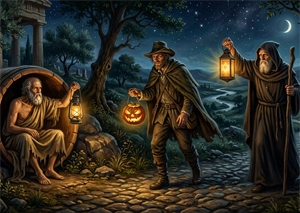
With the arrival of October, the days get shorter and the Halloween atmosphere begins to permeate everyday life. Our imagination is inevitably captured by a visual icon of rare and visceral power: the figure of the solitary traveler who advances in the darkness holding a lantern. Long before pop culture transformed the carved pumpkin into a commercial gadget, the gesture of protecting a flame in the autumn night responded to a deep symbolic need of the human psyche.
October has always been the month of the threshold, the time in which the veil between light and shadow thins. If we carefully observe the history of thought, the folklore of the nights of Samhain and esoteric wisdom, we notice that this wanderer of light is not an isolated figure, but is mainly embodied in three fundamental figures: Diogenes of Sinope, the Cynic philosopher who challenges society during the day; Stingy Jack, the damned man of the Irish tradition who gives rise to Halloween; the Hermit, the Arcanum IX of the Tarot who uses the lantern to exclusively illuminate the next steps in the darkness of his inner investigation.
Three distinct itineraries, three opposing intentions, a single symbolic instrument. Let’s explore this conceptual triangle to understand how these three flames illuminate the most remote corners of the human condition precisely in the season of darkness.
1. Diogenes of Sinope: the lantern by day and the provocation of the polis
To reach the first point in this constellation, we need to jump back to the fourth century BC and the crowded, noisy streets of classical Athens. Here we meet Diogenes of Sinope, the philosopher who made provocation his lecture hall and the street his home. Living with the bare minimum, he embodied the most radical form of Cynicism. Tradition has him sleeping in a large earthenware storage jar, a pithos.
The daylight gesture and the search for a human being
The most famous anecdote, handed down to us by Diogenes Laertius1, sees the philosopher wandering around the market in broad daylight with a lit lantern in his hand. To anyone who asked him the reason for such a bizarre and apparently senseless gesture, he replied succinctly: “I’m looking for man” (that is, an authentic, virtuous human being not altered by social superstructures and hypocrisies).
Diogenes’ use of light is a refined operation of philosophical satire:
- Light against illusion: turning on a lamp under the dazzling sun means denouncing an inner blindness. Civil society, while believing itself to be enlightened by culture, politics and commerce, actually shines with a false light, remaining sunk in the darkness of conformism.
- Voluntary exile: Diogenes is not simply someone society has cast out; he chooses exile. He rejects written laws, titles, and conventions in order to live according to nature. His lantern points outward, trained on passersby like a spotlight to expose their contradictions.
- Confronting power: He showed the same attitude toward Alexander the Great. When the most powerful commander in the ancient world stood before him and offered him anything he wanted, Diogenes simply replied: “Move. You’re blocking my sunlight.” True virtue does not ask authority for favors; it merely claims its natural light.
In Diogenes, the lantern is a critical tool, an intellectual weapon hurled against the conformity of the polis. It is the fire of reason that refuses to bow to compromise.
2. Stingy Jack: the founding myth of Halloween and the condemnation to limbo
Moving from the squares of ancient Greece to the foggy moors of 18th century Ireland we come across the beating heart of Halloween folklore: Stingy Jack.
The figure of Jack is part of an older story. The term jack-o’-lantern is older than the pumpkin. The Oxford English Dictionary records it in 1658 as a name for the wandering lights of the marshes, then between 1663 and 1704 for a man carrying a lantern, the night watchman, and only in 1837 for a carved turnip2. The subsequent Irish legend of Stingy Jack, traditionally placed in the 18th century, provided a folkloric explanation of the name and figure of the wanderer condemned to carry a lantern into the darkness.
If Diogenes chooses poverty to pursue virtue, Jack chooses deception, selfishness and completely sterile cunning. His story, passed down orally and which has become the true founding myth of the festival, tells of a drunken and manipulative blacksmith capable of fooling even the devil himself.
The trap, the ember and the genesis of the pumpkin
Legend has it that Jack invited the devil for a drink. Unwilling to pay, he persuaded the devil to turn himself into a coin. Instead of settling the bill, Jack pocketed it beside a silver cross, preventing the devil from returning to his original form. He later released him on the condition that he would not claim Jack’s soul for another ten years.
When the time was up, Jack tricked the devil again, persuading him to climb a fruit tree. Jack then carved a cross into the trunk. In exchange for releasing him, he demanded that the devil never claim his soul, for all eternity.
But Jack’s cunning proved to be a double-edged sword:
- The double metaphysical exile: upon his death, his dissolute and fraudulent life barred him from the gates of paradise. However, when he presented himself at the gates of hell, the devil, bound by the stipulated pact, denied him access. Jack thus found himself banished from both realms of the afterlife.
- The Samhain lantern: Terrified of spending eternity in the absolute darkness of limbo, Jack asked for a light. The devil contemptuously tossed him a burning ember straight from the fires of hell. To shelter it from the autumn winds and keep it glowing longer, Jack placed it inside a hollowed-out turnip, later replaced with a pumpkin by Irish emigrants to America.
Unlike Diogenes, Stingy Jack does not use the lantern to seek the truth, but to escape from total darkness. He is Halloween’s native embodiment: the stateless metaphysician condemned to wander the very nights when the boundaries between worlds fall. His lantern does not illuminate a philosophical path, but signals the failure of a soul that attempted to deceive even its own destiny.
3. The Hermit and alchemy: the search for the lumen naturae and the inner journey
Bringing together the threads of myth and autumn folklore, we reach the third point of this triangle: the Hermit, the ninth card of the tarot’s Major Arcana, closely associated with Western alchemical tradition and the symbolism of protective darkness.
If Diogenes looks to society to unmask it and Jack looks to the darkness to orient himself in his exile, the Hermit makes a radical inversion: he takes a journey in a stubborn and contrary direction, turning exclusively inward.
“The Hermit does not use the lantern to show the way to others nor to dazzle those in front of him. He uses it to see the single step that separates him from self-knowledge.”
The Tarot: the patience of Arcanum IX
Iconographically, Arcanum IX shows an elderly man, wrapped in a large dark cloak that protects him from the cold of the seasons and the distractions of the outside world. He holds a support stick (symbol of prudence and methodological rigor) and raises a lantern partially covered by his own clothing with his right hand.
- The six-pointed star: The flame enclosed in the Hermit’s lantern is no ordinary candle. In many iconographic traditions it contains the Seal of Solomon (the hexagram), an allegory of the alchemical marriage between fire and water, spirit and matter, sky and earth.
- A limited range: The Hermit’s lantern does not pierce the darkness far into the distance. It lights only the small space around his next step. This is the lesson of autumnal patience: to travel through the night of the unconscious, you do not need dazzling headlights, but a modest, steady, carefully guarded light.
Alchemy: the lumen naturae in raw material
In the symbolic language of alchemy, the Hermit embodies the philosophus who ventures fearlessly into the darkness of nigredo, the blackening stage: the chaotic, undifferentiated state of prima materia.
As theorized by Paracelsus and subsequently taken up by the analytical psychology of Carl Gustav Jung, the alchemist seeks the lumen naturae – the “light of nature”. It is a divine and rational spark hidden in the depths of raw matter, the truth hidden in the mud of the not yet purified psyche. The lantern is the alert consciousness that allows you to recognize the spiritual gold hidden in your own inner shadows.
4. Philology vs archetype: why history divides them and symbol unites them
A rigorous analysis imposes a clear distinction between the historical-philological level and the symbolic-archetypal one, especially when dealing with popular themes such as Halloween:
- Diogenes belongs to classical Greece of the 4th century BC. and is anchored in ancient philosophical historiography.
- Stingy Jack belongs to 18th century Irish folklore, while the term jack-o’-lantern and the turnip lantern tradition have documented antecedents at least as far back as the 17th century.
- The Hermit was born in the context of the Italian Renaissance within the decks of triumphal cards and was then integrated, between the 18th and 19th centuries, into the systems of esotericism and Western alchemy.
The three linguistic and cultural worlds are totally autonomous. No classical author knew about Halloween or Jack, just as Irish folk storytellers did not intend to build a Cynic philosophical theory.
Convergence in the collective unconscious
However, if on the historical level their paths proceed parallel without ever crossing, on the archetypal level they form a perfect constellation. They embody the three possible responses that human beings can give when they find themselves immersed in the darkness of their existence and in the cold season of the year:
- The critical response (Diogenes): Turning the light towards the world to denounce its falsity and seek moral purity.
- The defensive response (Stingy Jack): Using light as a mere survival tool to avoid being swallowed up by the void and becoming a victim of one’s own deceptions.
- The transformative response (the Hermit): Using the light to explore one’s interiority by integrating the shadow and silently guiding anyone seeking knowledge.
In conclusion, if we brought these three characters together in a dark room: Diogenes would use the lantern to insult Jack and analyze the Hermit; Jack would use his pumpkin to try to steal the Hermit’s cloak; the Hermit would ignore both and focus on the star inside his lantern knowing that each of them is walking their rightful path.
5. The comparative matrix of light bearers
To immediately grasp the subtle differences that define these three lantern wanderers we can summarize their nature through an analytical comparison grid:
| Figure | Nature of the lantern | Direction of travel | Fundamental Purpose | The highlighted shadow |
|---|---|---|---|---|
| Diogenes of Sinope (the provocateur) |
Critical reason / satire | External (In the polis and among men) |
Unmask social hypocrisies and look for the authentic man. | The illusion of conventions and the falsity of dominant culture. |
| Stingy Jack (the cursed man of Halloween) |
The infernal ember / the turnip or pumpkin lantern | Intermediate (in limbo between worlds) |
Avoid the pitch dark by wandering without destination or redemption. | The moral failure of sterile cunning and deception. |
| The Hermit (the alchemical sage) |
The lumen naturae / consciousness | Internal (in the psyche and in matter) |
Initiate oneself, transmute raw matter into spiritual gold. | Inner ignorance and haste that prevents maturation. |
6. The visual legacy and the message for autumn nights
From a strictly graphic and compositional point of view, the image of the lantern bearer has an unparalleled visual drama. The presence of a single, reduced light source isolated in the center of a scene dominated by absolute black generates a clear contrast (a Caravaggio-style chiaroscuro) that immediately captures attention.
At this time of year, as we approach Halloween night, the lesson of the three lantern bearers resonates with a particular force:
- It reminds us to be wary of easy mass enlightenment and passing fashions, as Diogenes taught.
- It warns us against the risk of building our own personal prison made of small deceptions and moral shortcuts, as evidenced by the tragedy of Stingy Jack.
- Above all, it invites us to rediscover the virtue of the Hermit: learning to enter our own inner darkness with a modest but unwavering light, knowing that the one journey truly worth making is the journey toward self-knowledge.
The common thread that unites these three figures is not the possession of an absolute truth or a magical object, but the solitary search in the darkness and the radical detachment from the rest of humanity. However thick the October darkness may be, a single carefully protected flame is enough to mark the path ahead.