Have you ever sat across from an HR recruiter, sweating under the office neon and dreading the inevitable question about your CV? “I see a six-month gap here between 2023 and 2024. What were you doing then?” And you, who spent those six months trying in vain to launch a podcast, binge-watching Netflix in your pajamas, and searching for yourself on the sofa, desperately try to repackage it all as a story the job market will accept: “I took a sabbatical to develop personal projects and strengthen my soft skills.”
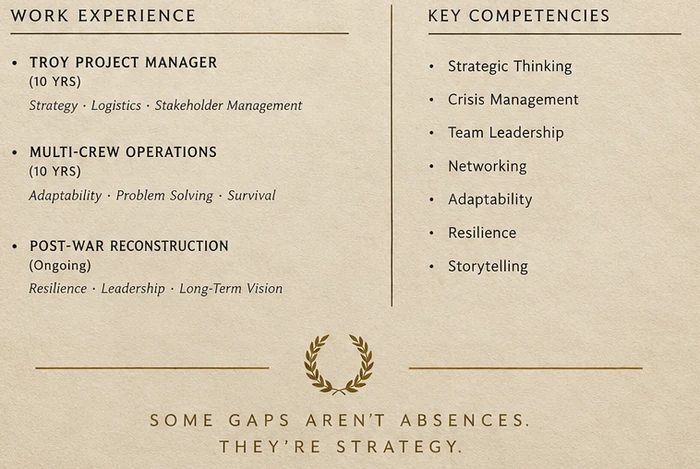
It’s a humbling moment for anyone. Modern society demands uninterrupted productivity, a timeline without gaps. But before you feel like a failure because that semester is missing from your INPS record (Italy’s social security system), pause and think of the greatest CEO in Greek mythology: Odysseus, king of Ithaca. Imagine you’re him. You’ve just successfully completed the “Troy Project,” a ten-year contract you personally brought to completion with the ingenious innovation of the Wooden Horse (a masterclass in lateral thinking). Your track record is impeccable. Then, on the way home, you vanish from the radar. For ten long years. No invoices, no LinkedIn updates, no official position. A gap of exactly a decade.
How do you introduce yourself to a potential new investor and explain that it took you ten years to cover a route that would take a couple of weeks by ferry? The trick isn’t what you lived through, but how you tell the story. Today we’re unpacking the greatest corporate pitch in literary history: the moment when Odysseus, naked on a beach, had to explain the biggest CV gap of all time.
 Save this image to Pinterest
1. The evaluation committee and the problem of chronology
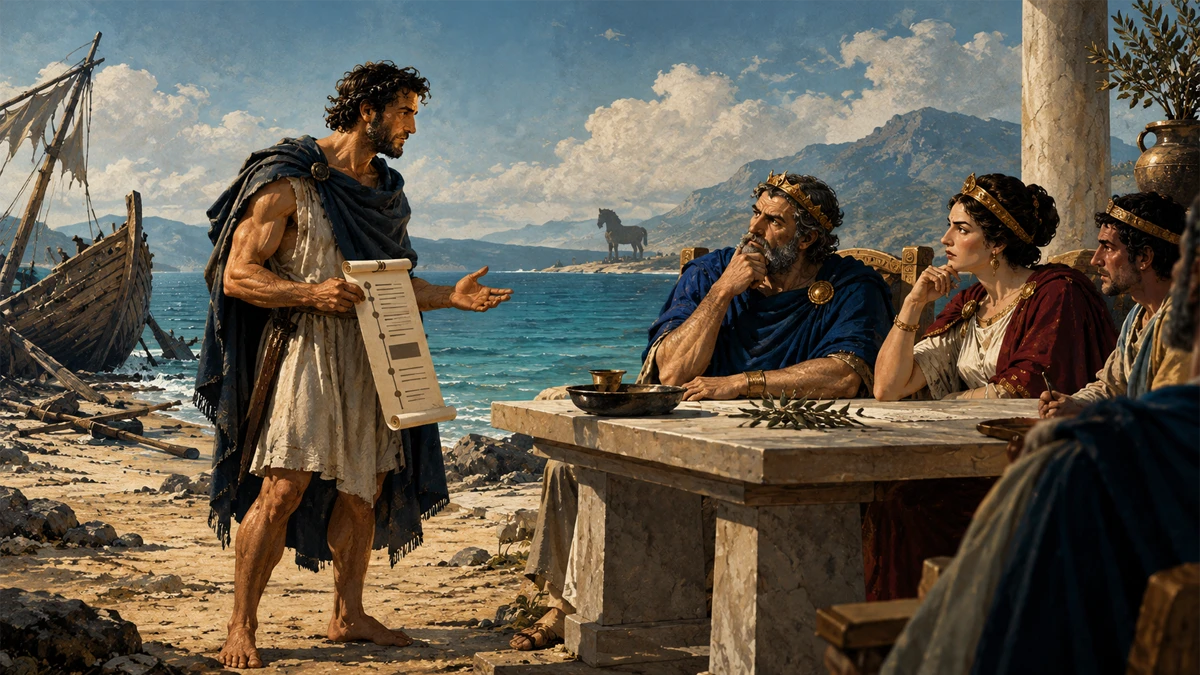
The scene unfolds in the palace of Alcinous, king of the Phaeacians. Odysseus has just been shipwrecked. He’s lost everything: his ships (the assets), his companions (the human resources), and his spoils (the capital). He desperately needs a ride back to Ithaca—in effect, he’s asking for a grant he never has to repay. Facing him is the entire Phaeacian board of directors, chaired by Queen Arete (the real decision-maker). To get a ship, he has to explain where on earth he’s been since Troy fell. Thus begins the celebrated cycle known as the Apologues of Alcinous: Odysseus’s tales of his adventures in Books IX–XII of the Odyssey.
A crucial detail escapes a first reading—a question for real philology nerds: Homer never gives us the internal chronology of this journey in the form of a convenient Gantt chart. The exact timing is left unstated; it is a fragmentary timeline reconstructed after the fact by cross-referencing the few details scattered through the poem. We know the war lasted ten years and the return journey another ten. But as Odysseus speaks, he has to fit his failures, pauses, and disasters onto a timeline that feels inexorable, almost inevitable, so he won’t come off as an incompetent manager.
2. The first years: failed startups and problematic personnel management
Odysseus starts listing the first stops, the first months after Troy. Translate his adventures into corporate jargon and you get an embarrassing run of bad management decisions and a hemorrhage of staff.
First stop: the Cicones. “I attempted a hostile takeover in the Ismarus market. We successfully sacked the city, but the team disobeyed my orders to evacuate quickly, lingered to party on the beach, and we suffered a devastating legal blowback (enemy reinforcements). We lost six men per ship.” Perfect spin-doctoring: the fault lies not with his planning, but with the workforce’s insubordination.
Second stop: the Lotus Eaters. “We faced a severe internal morale crisis. Some employees took a local substance (lotus) and completely lost alignment with the company mission (getting home). I had to resort to physical coercion, tying them beneath the ship’s benches, to ensure staff retention.”
But the real masterpiece of managerial revisionism comes with Polyphemus (Book IX). Here Odysseus makes a colossal mess. Driven only by curiosity and greed (he expects the customary gift of hospitality), he enters the cave of a cannibal giant uninvited. He gets himself trapped inside. Six of his best men are eaten raw. This is the textbook definition of a toxic work environment and appalling risk assessment. How does he tell it to the Phaeacians? He turns it into a triumph of crisis management. He glosses over his initial responsibility and focuses on how he solved the problem: blinding the competitor and brilliantly rebranding himself as “Nobody,” thereby saving the core business (himself).
3. The disaster of delegation and ruthless downsizing
If you think the gap explanation is getting better, just wait. Odysseus reaches Aeolus, lord of the winds, who gives him an invaluable gift: a bag containing all the adverse winds. The route to Ithaca is clear; after nine days at sea, they can see the fires of home. The goal is within reach. And what happens? Odysseus, who has gone nine days without sleep because he refuses to hand over the helm, finally nods off. His companions, convinced the bag contains gold their boss wants to keep for himself, open it. The winds burst out and drive the fleet all the way back to where it started.
How does he justify this to the Phaeacian HR department? “There was a catastrophic lack of trust and shared values between the executive (me) and the operational team (the crew). My extreme micromanagement was justified: the moment I delegated responsibility, the team blew the entire project.”
That failure leads to the next stop: the Laestrygonians. Cannibal giants destroy eleven of the fleet’s twelve ships, massacring almost everyone. Odysseus survives because he had prudently moored his ship outside the harbor. How do you tell that story without sounding like a coward? Easy: frame it as an unavoidable round of layoffs. It was brutal, traumatic downsizing, but necessary to streamline the company. We go from a multinational with twelve ships to a lean, agile outfit with a single operating unit. We set off light.
4. The ultimate employee-benefits package: a sabbatical with Circe
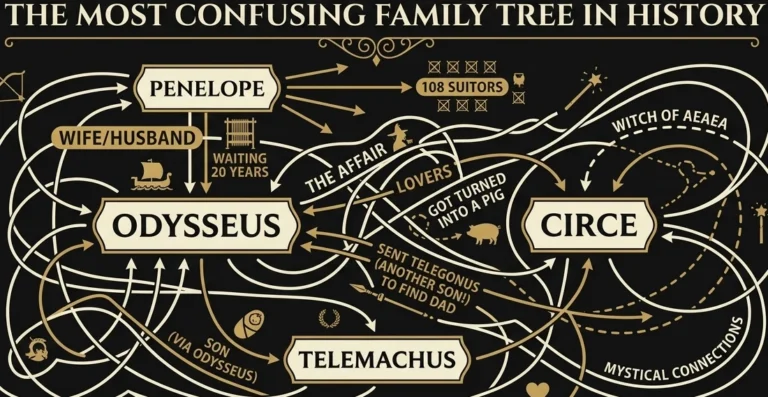
We reach one of the hardest gaps to explain: Aeaea, the island ruled by the sorceress Circe. After an initial, tragic misunderstanding (half the team turned into pigs), Odysseus, with Hermes’s help and a healthy dose of personal charm, fixes the situation. He turns the employees back into humans. At that point, they should logically set sail the next morning and head home. But they don’t.
In Book X of the Odyssey, Odysseus has to admit to the Phaeacians how long they stayed on the island: “There for a whole year we stayed / feasting on plentiful meat and sweet wine”1.
A whole year. Three hundred and sixty-five days. What did the great hero, tormented by homesickness, do? He ate meat, drank sweet wine, and slept in a goddess’s bed while the ship rotted on the beach. How do you justify a year of total inactivity in the middle of a supposed race against time to save your homeland?
Odysseus’s version is a masterclass in evasion. He recasts the stay as a period of “holistic team-building.” The crew was exhausted, traumatized by previous losses. They needed time to recover. And there was an invaluable networking opportunity: Circe had strategic information for the rest of the voyage. To persuade her to cooperate, he had to cultivate good relations. If that meant feasting for twelve months and sharing the sorceress’s bed, it was a corporate sacrifice Odysseus was willing to make. Eventually, his companions had to take him aside and remind him it might be time to get moving again. The sabbatical had got out of hand.
5. Deep dive into historical data and risk management
The journey resumes, but Circe sends him on a detour that looks great on the CV: a trip to the Underworld (Book XI). Odysseus doesn’t tell the Phaeacians, “I wasted more time.” He says, “I did high-level external consulting with the senior partners who had retired.” He went down to Hades to consult the prophet Tiresias and speak with Agamemnon, Achilles, and Heracles. He conducted predictive analysis of future risks. Initiative, courage, respect for the classical hierarchy—it’s all there.
When he sets sail again, he applies what he has learned to the letter. They reach the Sirens. How does he manage the risk? With a degree of micromanagement that would make Jeff Bezos jealous. He plugs his employees’ ears with wax (shielding them from external threats but stripping them of all decision-making autonomy), while having himself tied to the mast so he alone can access the unfiltered information (the song).
Then Scylla and Charybdis. He knows he will lose six men devoured by Scylla, but he doesn’t tell the crew so as not to create panic. Pure cynicism? No, loss optimization. Passing near Charybdis would have meant losing the entire ship; passing near Scylla is a calculated operating cost. Odysseus is the manager who sacrifices six pawns to save the division.
6. The ultimate black hole: seven years on Ogygia under an NDA
But all these adventures, however tragic or prolonged (the year with Circe), account for no more than three years. Most of the explanation is still missing. After yet another disaster caused by his crew—who ignore his orders and eat the Sun god’s sacred cattle—Zeus strikes the ship with lightning. Everyone dies. Everyone but the CEO. Odysseus is shipwrecked alone on the island of Ogygia. And then the timeline comes to a dramatic halt.
On the island lives Calypso, a beautiful, immortal nymph in love with him. And how long does he stay, Odysseus, on this remote island, far from the trade routes? Seven years. He admits as much to Queen Arete in Book VII, even before launching into his long, detailed account: “I stayed there for seven years, and continually / soaked with tears the immortal clothes Calypso gave me”2.
Seven years. The ultimate black hole on his CV. Eighty-four months spent eating and drinking like a mortal and sleeping with a goddess, while by day he wept on the rocks, staring at the horizon. The ambrosia and nectar, meanwhile, were Calypso’s.3 How can he sell this to the Phaeacians without sounding like a luxury retiree at an all-inclusive resort, pretending to suffer captivity?
Odysseus pulls it off by framing the story around helplessness and a duty of secrecy. He tells it as if he had signed a binding NDA (Non-Disclosure Agreement) with a higher power. He was held hostage. No ships, no sailors, no network coverage to send an SOS. It was forced inactivity, exile, a gilded captivity he recoiled from psychologically. “I bathed my immortal robes in tears” is the key line. Odysseus is saying: “Yes, I wore designer clothes and enjoyed divine benefits (she even offered me immortality, which I refused), but trust me, my professional self was suffering deeply. My mindset was always set on Ithaca.”
In effect, Odysseus recasts the seven years as a tragic exile and a staggering display of resilience. “I didn’t give up, even when a rival company offered me a permanent contract with immortality included.” Believe it or not (Homer slyly hints that our hero, at night, did not entirely disdain Calypso’s attentions), it’s a brilliant defense.
The moral of the survival narrative
When Odysseus finishes speaking (at the end of Book XII), silence falls over the Phaeacian hall. King Alcinous is enthralled. He is not weighing whether Odysseus’s choices were ethically impeccable, whether he took too long, or whether hundreds of people died under his watch. He is judging the sublime way the hero held the fragments of his shattered identity together. Odysseus has turned an embarrassing timeline of defeats, overlong pauses, divine lovers, and massacres into an epic of survival, endurance, and intelligence.
The ten-year gap is filled by the power of storytelling. Odysseus gets a ship laden with gifts (a job, funding, a fresh start). He will return to Ithaca in triumph.
The lesson Homer leaves us, hidden between the lines of these chronological gaps, is immense. The distance between how we live through interruptions in our lives and how we tell others about them is a precise measure of our social intelligence. Each of us has our storms, our years lost to one Circe or another, or spent stranded on the rocks of an emotional Ogygia, unable to move, weeping over ourselves as time passes.
We cannot erase the gaps from the CV of our lives, but we can choose how to talk about them. Next time someone asks about a period of stagnation, a failure, or a year when you simply drifted, don’t look down. Take a deep breath, fold your hands on the table, put on the look of someone who survived a cosmic shipwreck, and tell your own version of the Odyssey. Remember: the only thing separating a failure from a legendary hero is a brilliant in-house PR team.
Notes
- Homer, Odyssey, Book X, lines 467–468 (author’s own translation). Perseus Digital Library. ↑
- Homer, Odyssey, Book VII, lines 259–260 (author’s own translation). Perseus Digital Library. ↑
- Homer, Odyssey, Book V, lines 195–200. Perseus Digital Library. ↑