If social networks, corporate training rooms, and sellers of motivational courses have one thing in common, it is the compulsive urge to lift literary quotations out of context and print them on mugs, PowerPoint slides, or LinkedIn bios. And no victim is more famous in this meaning-shredding machine than the tercet with which Ulysses ends his speech in Canto XXVI of Dante Alighieri’s Inferno: “Consider ye the seed from which ye sprang; / Ye were not made to live like unto brutes, / But for pursuit of virtue and of knowledge.”1
Read that way, it sounds like a hymn to human potential, a luminous invitation to push past your limits, refuse mediocrity, study, explore, and monetize. It is the line you would expect to hear from a resurrected Steve Jobs at a graduation ceremony. The perfect aphorism for tattoos and T-shirts.
There is just one tiny, insignificant philological detail the self-appointed gurus of personal growth constantly forget: in Dante’s poem, the speaker is a soul damned to Hell, burning inside a two-horned flame in the Eighth Bolgia. Why is he burning there? Dante has classified him as a “fraudulent counsellor”2. In other words: a word-thief, a serial manipulator, someone who used his intelligence not for the common good but to cheat others through deception.
Today we are dismantling this colossal misunderstanding and examining the dark masterpiece that is Dante’s Ulysses. It is a fascinating journey in which Aristotelian philosophy collides with medieval theological terror—and in which we discover that the old king of Ithaca is not the romantic hero of exploration, but the prototype of the toxic manager who drives his entire company to ruin and drowns every employee just to feed his own ego.
1. The speaker’s résumé: the Ulysses Dante never read
To understand Canto XXVI, you first have to reset everything you know about the Odyssey. Pretend the homeward journey, the tears for Penelope, the dog Argos, and the olive-wood bed never existed. Why? Because Dante did not know Greek and had never read Homer in the original.3 His Ulysses is not born of a direct reading of the Iliad and the Odyssey, but of a dense web of Latin and medieval retellings.
In the Western Middle Ages, the substance of Homer’s poems had not disappeared; it circulated in recast, abridged, and extensively reinterpreted forms. Among the main building blocks Dante used to construct his version of the king of Ithaca were the poetry of Virgil and Ovid’s Metamorphoses4, alongside possible philosophical echoes of writers such as Cicero and Seneca.
Here the perspective flips completely. The Romans considered themselves descendants of Aeneas, the Trojan exile; their epic tradition therefore regarded Troy’s Greek conquerors with suspicion and reserve. In this partisan narrative, Ulysses is not the wise, homesick hero of the homecoming, but a cunning and ruthless enemy. He is the man Virgil calls “scelerum inventor”, “inventor of crimes”5: the manipulator who devised the Trojan Horse to bring down a city that could not be defeated in open battle.
When Dante encounters Ulysses, he finds him in the Eighth Bolgia of Hell, where the fraudulent counsellors are punished. The contrapasso is perfect: in life they used language to conceal their true intentions; in Hell they are concealed inside tongues of fire that burn them forever. Ulysses shares a single flame, split at the tip, with his fellow fraudster Diomedes. They are the mythological scam’s ultimate double act.
But Dante, a towering intellectual, cannot bring himself to hate Ulysses. He is terrified of him and drawn to him at the same time. He admires him deeply because he recognizes in him the same, identical, dangerously persistent illness: an infinite, inexhaustible thirst for knowledge.
2. The homecoming that never happened (and the immediate getaway): absent-father syndrome
In the story Ulysses tells Dante, there is a prologue that ought to set off every alarm in the world. When the king of Ithaca finally leaves Circe (who had kept him near Gaeta for more than a year), he faces a choice: finally return home after years of war, or give in to his obsession with travel.
His decision is chillingly cold: “Nor fondness for my son, nor reverence / For my old father, nor the due affection / Which joyous should have made Penelope, / Could overcome within me the desire / I had to be experienced of the world, / And of the vice and virtue of mankind;”6
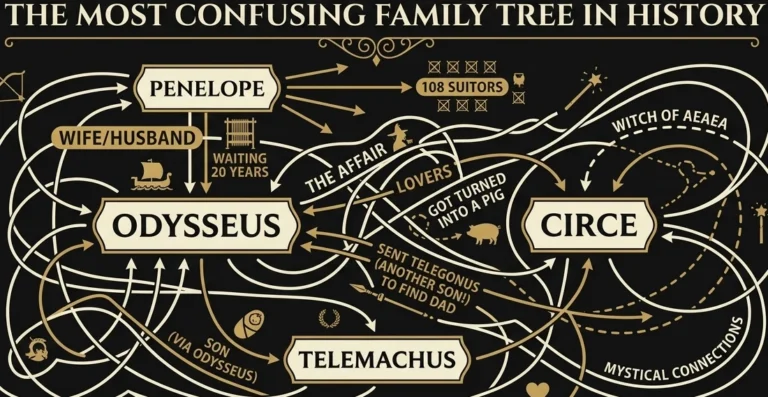
Translation: love for his son Telemachus, pity for his elderly father Laertes, and his marital duty to Penelope (waiting at home, unravelling her weaving like a madwoman) are not enough. They cannot overcome—even at a distance—his appetite for exploration. Ulysses does not choose to return; he chooses to flee forward, giving up the chance to embrace his family for one more trip around the world.
He gathers “that small company / By which I never had deserted been”7—the handful of wretched survivors who had stuck with him—and heads due west. Toward the edge of the open world. And that is where the disaster begins.
3. The “Orazion Picciola”: the perfect manipulator’s corporate pitch
Here we are at the big moment. Ulysses’ ship reaches the Strait of Gibraltar, between the Pillars of Hercules. In the theological and geographical imagination of the Middle Ages, this was the non plus ultra, the God-set boundary beyond which people should not venture past the inhabited lands, into the terrifying, empty Atlantic Ocean.
The sailors stop when they reach the strait. They are afraid. By Ulysses’ own admission, they are “old and slow.”8 They have sailed for decades; all they want is to retire, go ashore, eat a hot bowl of soup, and die in their own beds.
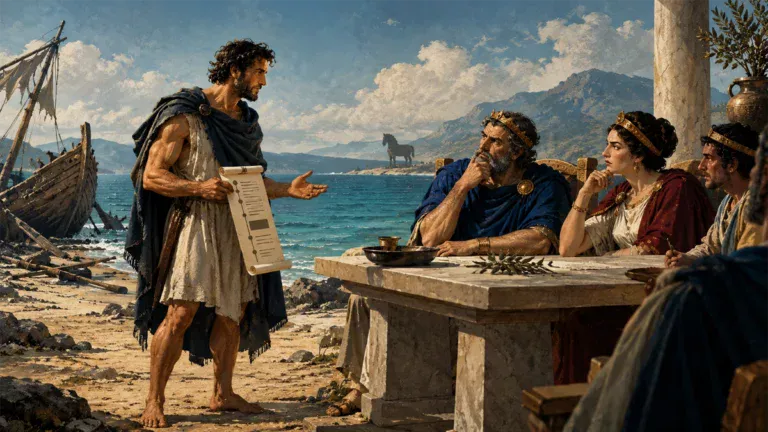
What would a good leader do in this situation? Assess the team’s physical condition, recognize the limit, and turn back. What does Ulysses do? He delivers what Dante calls an orazion picciola (a little speech), which may be the most brilliant, toxic, and lethal exercise in gaslighting ever recorded in world literature.
Here are the exact words, taken apart and analysed:
“O brothers, who amid a hundred thousand
Perils,” I said, “have come unto the West,
To this so inconsiderable vigil
Which is remaining of your senses still
Be ye unwilling to deny the knowledge,
Following the sun, of the unpeopled world.
Consider ye the seed from which ye sprang;
Ye were not made to live like unto brutes,
But for pursuit of virtue and of knowledge.”9
First move: flattery and guilt. He calls them “brothers.” He is no longer their stern king; suddenly he becomes one of them, an equal. He reminds them that they have survived “a hundred thousand dangers,” stroking their pride as veterans. Then comes the jab: he calls the time they have left to live “this brief vigil of our senses.” He is saying: “Guys, you’re old, one foot in the grave, maybe three days of clear thinking left. Do you really want to waste that last scrap of time vegetating on the sofa, refusing the chance to explore the uninhabited hemisphere beyond the sun?”
And then, to deliver the logical coup de grâce and crush whatever resistance his exhausted employees have left, he drops the motivational weapon of mass destruction:
“Consider ye the seed from which ye sprang;
Ye were not made to live like unto brutes,
But for pursuit of virtue and of knowledge.”
Ulysses is using the purest philosophy to commit an act of fraud. Aristotle’s basic principle is that “all human beings by nature desire to know”10. Knowledge is what separates human beings from animals (“brutes”). Ulysses uses this lofty truth to persuade his crew to commit collective suicide and a theological sacrilege. He turns their caution into bestial cowardice and backs them into a corner: “If you turn back, you are beasts. If you are truly human, come with me beyond the Pillars.”
The result? Collective euphoria. Ulysses himself admits to Dante: “So eager did I render my companions, / With this brief exhortation, for the voyage, / That then I hardly could have held them back.”11 He has literally hypnotized and electrified them, turning them into kamikazes ready to crash.
4. The “mad flight”: anxiety at the boundary between Christianity and the classical world
At this point, the ship passes the Pillars of Hercules and launches into the unknown ocean. Ulysses describes the voyage as a “mad flight”12 They know they are doing something reckless, but they cannot stop. The oars become wings. They sail for five months in the southern hemisphere, where the night sky has different stars, until a very tall, dark mountain appears on the horizon: Mount Purgatory.
This is the dramatic heart of the canto, and the real reason you should never tattoo that quotation thinking it is a compliment. For an ancient Greek, virtute (excellence, aretē) and the thirst for knowledge were ends in themselves. The more you discovered, the more you were worth. But Dante is no ancient Greek. He is a fourteenth-century intellectual, steeped in Thomistic theology13.
In Dante’s cosmos, human knowledge without divine Grace is hybris (overweening pride, arrogance). Human intellect has structural limits. Crossing the Pillars of Hercules is not the brave act of a National Geographic explorer: it is blasphemous hubris. It means trying to penetrate God’s secrets by human reason alone (the ship), without Revelation and without a spiritual guide. It is the original sin of Adam and Eve, replayed at sea.
Dante, a man in love with philosophy and science, feels frighteningly close to Ulysses. He knows he too could lose himself in the intellect’s “mad flight.” That is why he has to punish him so mercilessly.
5. The startup’s collapse: shipwreck and intervention from on high
How does this exploration at the edge of the cosmos end? Just as the sailors catch sight of Mount Purgatory, joy instantly turns to tears. A sudden whirlwind rises from the newly discovered land and strikes the ship’s bow.
The ship spins around three times, like an apocalyptic washing machine. On the fourth turn, the stern lifts toward the sky, the bow plunges toward the ocean floor, and the sea closes over them, swallowing everyone without mercy. “Until the sea above us closed again.”14 is one of the coldest, most final, most terrifying lines in the whole Divine Comedy.
Who unleashed the whirlwind? Ulysses says, “as pleased Another” (the Italian is com’altrui piacque) 15. He cannot even bring himself to say God’s name. He calls him “the other.” It is the final defeat. The universe has answered his arrogance by brutally restoring the prohibition he broke. There are no survivors and no glory. His thirst for knowledge has brought no discoveries; it has condemned him and his poor, exhausted sailors, swept away by their superior’s delusions of grandeur.
Conclusion: a field guide to toxic enthusiasm
The next time you are in a corporate meeting and your manager pulls out Dante’s famous lines to persuade you to work thirteen hours of unpaid overtime or embrace “challenging challenges” and “disrupting objectives,” do not nod along like the old sailors of Ithaca.
Take a deep breath and remind them of the context. Remind them that “Ye were not made to live like unto brutes” is the opening line of a deadly fraud.
Pursuing virtue and knowledge matters. But recognizing motivational nonsense (and keeping a life jacket within reach) matters even more.
And yet “Consider ye the seed from which ye sprang; / Ye were not made to live like unto brutes, / But for pursuit of virtue and of knowledge.” is still a line that gets us fired up—or am I wrong?
Notes
- Dante Alighieri, The Divine Comedy, vol. I (Boston: Ticknor and Fields, 1867), Inferno, Canto XXVI, vv. 118–120, trans. Henry Wadsworth Longfellow. Text. ↑
- Dante Alighieri, Inferno, XXVI, vv. 52–63, trans. Henry Wadsworth Longfellow (edition cited in note 1). ↑
- On Dante’s lack of direct access to Homer: Princeton Dante Project, “Homer” entry. ↑
- Ovid, Metamorphoses, XIII. ↑
- Virgil, Aeneid, II, 164: scelerumque inventor Ulixes. ↑
- Dante Alighieri, Inferno, XXVI, vv. 94–99, trans. Henry Wadsworth Longfellow (edition cited in note 1). ↑
- Dante Alighieri, Inferno, XXVI, vv. 100–102, trans. Henry Wadsworth Longfellow (edition cited in note 1). ↑
- Dante Alighieri, Inferno, XXVI, vv. 106–108, trans. Henry Wadsworth Longfellow (edition cited in note 1). ↑
- Dante Alighieri, Inferno, XXVI, vv. 112–120, trans. Henry Wadsworth Longfellow (edition cited in note 1). ↑
- Aristotle, Metaphysics, I.1, 980a21. ↑
- Dante Alighieri, Inferno, XXVI, vv. 121–123, trans. Henry Wadsworth Longfellow (edition cited in note 1). ↑
- Dante Alighieri, Inferno, XXVI, v. 125, trans. Henry Wadsworth Longfellow (edition cited in note 1). ↑
- This alludes to Thomas Aquinas and the Thomistic theological tradition. ↑
- Dante Alighieri, Inferno, XXVI, v. 142, trans. Henry Wadsworth Longfellow (edition cited in note 1). ↑
- Dante Alighieri, Inferno, XXVI, v. 141, trans. Henry Wadsworth Longfellow (edition cited in note 1). ↑