Let’s be honest. If a higher power or a Silicon Valley billionaire offered us a pill tomorrow morning that guaranteed eternal life, our primal survival instinct would probably scream at us to say yes. We live in an age obsessed with biohacking, life extension, anti-aging serums, and the idea that death is just an annoying bug in the human operating system that we’ll eventually figure out how to fix.
But the Greeks, who understood tragedy and cruel irony millennia before us—and before Dorian Gray—left us a chilling warning. A full-blown literary trauma that reminds us of a fundamental rule of the universe: never sign a contract with a deity without first consulting a ruthless team of lawyers. And above all, always, always, read the fine print.
Welcome to the story of Tithonus. It isn’t an epic tale of battles or sea monsters, but it may be the most devastating psychological body-horror story in classical antiquity. A cynical parable about the consequences of our worst decisions.
The goddess with a weakness for mortals and the Trojan prince
To understand the disaster, we need to meet the protagonists. On one side is Eos, goddess of the dawn, whom Homer poetically calls “rosy-fingered.” Eos has a beautiful job: every morning she opens the gates of the sky to the chariot of the Sun, scattering the night. But Eos also has a small design flaw: an absolute, almost pathological preference for handsome mortal boys. She falls in love compulsively, kidnaps them, and carries them off (she will do the same with Orion, Cephalus, and many others).
On the other side is Tithonus. He isn’t just anyone: he is a prince of the royal house of Troy (brother of King Priam, for those keeping score). He is young, of divine descent, and described as breathtakingly beautiful, almost supernaturally so. He is literally the Bronze Age’s “beautiful and impossible” heartthrob.
One day Eos sees him, falls head over heels, and does what Greek divinities always do when they want something: she takes it. She kidnaps him and brings him to live with her in her golden palace at the ends of the earth. So far, it looks like a classic mythological happily-ever-after. They love each other; they live in a celestial palace; everything is perfect. But there’s an elephant in the room the size of Mount Olympus: Eos is an eternal goddess, while Tithonus is a human being made of flesh, blood, and, above all, a limited lifespan.
The audience with the CEO: the oversight that ruins eternity
Eos is terrified that sooner or later her beautiful lover will grow old, die, and descend into the dark realm of Hades, leaving her alone. So she decides to act pre-emptively and knocks on the office door of Zeus, the undisputed CEO of the gods, who has the power to overturn the laws of biology.
Before the Father of the Gods, Eos kneels and pleads: “Please, grant Tithonus immortality. Make sure he never has to die, that he can escape the Fates and live by my side forever.”
Zeus, who was probably in a bad mood that day—or simply adored cosmic black humor—agrees. He grants Tithonus the gift of being unable to die.
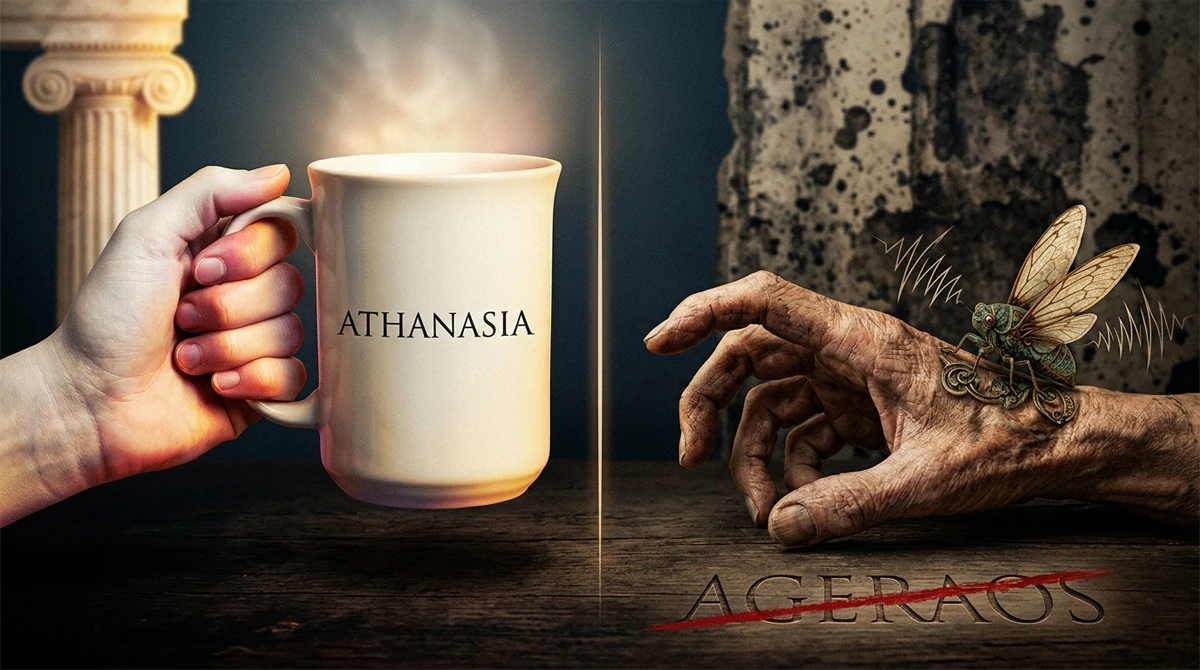
But Eos, blinded by love and urgency, commits the most spectacular bureaucratic blunder in the history of literature. She asks for immortality (in Greek, athanasia, the absence of death), but forgets to ask for eternal youth (ageraos, the absence of old age).
As the Homeric Hymn to Aphrodite—the most authoritative ancient source on this myth—tells us so brilliantly, Zeus grants Tithonus exactly what was put into words. Not a syllable more, not a syllable less. It is the classic literary trope of The Monkey’s Paw: you get what you wish for, but in the most literal and catastrophic way possible.
Decay: body horror stretched over centuries
The first years, decades, perhaps even the first century, go smoothly. But then, inexorably, Tithonus’s biology starts sending the bill. His dark hair begins to turn white. His radiant skin starts to fill with wrinkles. His joints begin to creak.
Eos watches her lover grow old and, with the ruthless superficiality typical of Greek gods (who cannot tolerate ugliness and decay), begins to distance herself. She stops sharing his bed.1 She still feeds him ambrosia and nectar to keep him alive and gives him luxurious clothes, but love turns into a mixture of revulsion and pity.
But the real horror is only beginning. Tithonus keeps aging—far beyond the human limit. Imagine a man who reaches 150, then 200, then 300. His body wears away; his muscles atrophy until they disappear; his bones turn to dust. He can no longer move even a finger. He cannot walk or stand. He is a shrivelled shell, a biological wreck trapped in an eternal sentence.
The Homeric Hymn to Aphrodite describes him with a clinical coldness that makes your blood run cold: when Tithonus loses even the strength to lift his limbs, Eos makes her final decision. She shuts him in a room in the palace, bars the gleaming doors, and leaves him there. For eternity, all that can be heard from behind those closed doors is Tithonus’s voice. A voice stripped of every trace of human warmth, reduced to a continuous, high-pitched, inarticulate, incomprehensible babble.
The cicada: the desperate song of decrepitude
The Greek gods don’t like to leave things half-finished, and pity isn’t their strong suit. According to the tradition that comes after the Homeric Hymn to Aphrodite, Tithonus undergoes one final transformation, completing the story of this pathetic, wrinkled being who could not die: overcome by his body, worn down by an eternity of decay, Eos eventually turns him into a cicada (tettix in Greek).3
The choice of a cicada isn’t incidental. In antiquity, people believed these insects fed exclusively on dew (a poetic and cruel link to the goddess of the dawn herself) and could renew themselves endlessly by shedding their old skin. In reality, a cicada sheds its exuvia, the shell of its nymphal exoskeleton that the adult leaves behind.4 A dry, hollow, seemingly immortal shell—just like the body that imprisoned Tithonus.
Tithonus thus becomes the insect that spends the summer chirring obsessively and shrilly. The voice that once whispered words of love to a goddess is condemned to become an irritating, mechanical background noise, emptied of all meaning. Immortality without health isn’t a gift: it is a maximum-security isolation cell in which your own body becomes your jailer.
The classical myth of nihilism: Tithonus and the cicada
Why does this millennia-old story feel so compelling today?
Because Tithonus is the patron saint of terrible decisions. He is the emblem of a polished nihilism. In a web flooded with images of colorful butterflies symbolizing rebirth, personal growth, and positive energy, Tithonus’s cicada stands as a dark, rebellious, deeply disillusioned symbol.
The butterfly says: “Spread your wings and be reborn.” Tithonus’s cicada whispers: “Eternity is a scam; enjoy the time you have before you turn to dust.”
It is a myth for anyone who loves tragic literature, appreciates Stoicism, or has ever made a rash decision they bitterly regretted. Alfred, Lord Tennyson dedicated a heart-rending poem to Tithonus, with unforgettable lines such as:
The woods decay, the woods decay and fall,
The vapours weep their burthen to the ground,
Man comes and tills the field and lies beneath,
And after many a summer dies the swan.
Me only cruel immortality
Consumes: I wither slowly in thine arms,
Here at the quiet limit of the world,
A white-hair’d shadow roaming like a dream
The ever-silent spaces of the East,
Far-folded mists, and gleaming halls of morn2.
[…]
The final lesson?
The story of Tithonus and Eos is a ruthless reminder that time is not our enemy; it is also what gives our existence meaning and value.
So the next time we walk under the summer sun and hear the deafening chirring of a cicada hidden among the branches, let’s not think only of the heat or of nature. Let’s stop for a moment, listen to that shrill, repetitive sound, and remember the beautiful prince of Troy.
When we sign a contract, let’s think of Eos and put on our glasses to read the marginal notes.
When we speak, let’s choose our words carefully, knowing that someone might always take us literally and teach us a lesson.
Notes
- Perseus Digital Library, Homeric Hymn to Aphrodite, 228–232. ↑
- Alfred, Lord Tennyson, Tithonus, Poetry Foundation. ↑
- Richard Janko, “Tithonus, Eos and the cicada in the Homeric Hymn to Aphrodite and Sappho fr. 58”, in The Winnowing Oar: New Perspectives in Homeric Studies, 2017, pp. 267–296. ↑
- University of Maryland Extension, Cicadas in Maryland. ↑