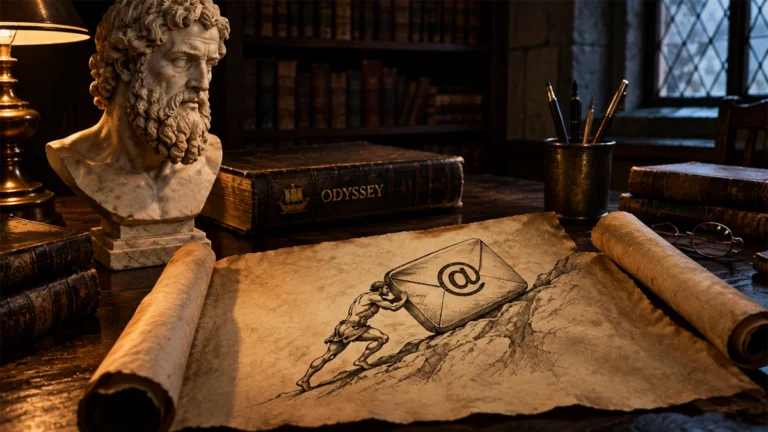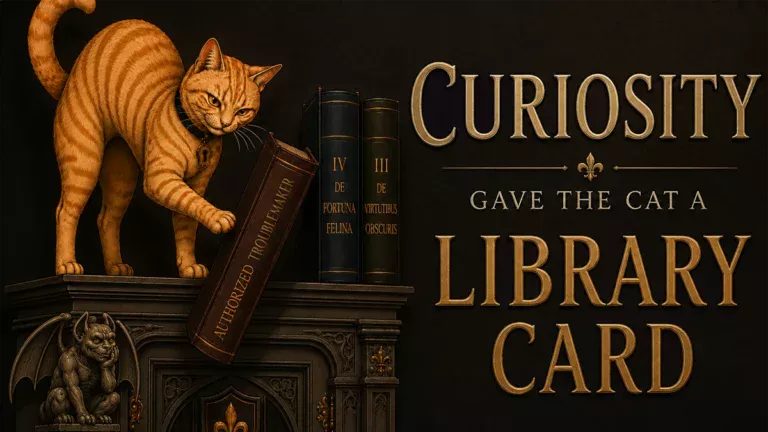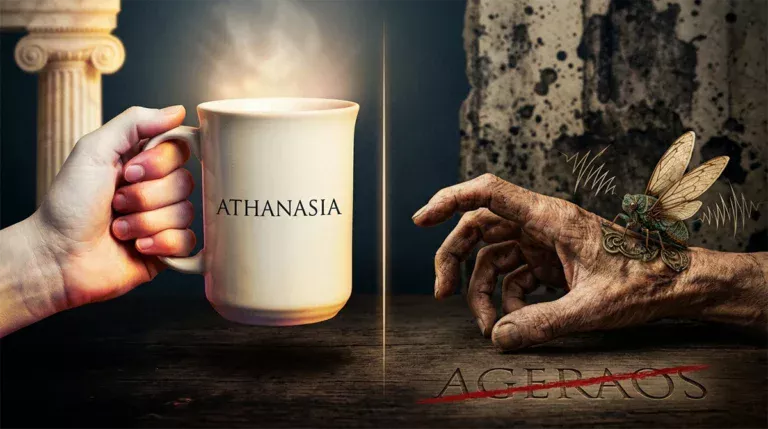
A recurring temptation runs through classical mythology and folklore: ignoring a prohibition, especially when it is stated plainly. If a god, an enchantress, a fearsome ruler of the Underworld, or a Cretan engineer tells you, “You can do anything you like, but don’t do X,” you can bet that the mortal in question will do exactly X, usually with disastrous consequences.
This is the great tragedy – or grand comedy – of the human condition. In the Olympian operating system, prohibitions often seem to work like irresistible psychological bait. The Greeks had a word for meddlesome curiosity, the urge to poke your nose where it does not belong: periergia. In Latin, a related term is curiositas; Plutarch describes indiscreet curiosity as a disease of the soul.
Today we’ll revisit some of the most disastrous cases of ignoring terms of service in myth: from the seas of the Odyssey to the caves of the Underworld, these characters seem to suffer from chronic inattention to signs reading “NO ENTRY.”
1. Aeolus’s bag of winds – the suspicion that turned the fleet back
To see how far a lack of self-control can undo a plan when success is within reach, just reread Book X of the Odyssey. Odysseus and his companions reach the floating island of Aeolia. Aeolus, keeper of the winds, is extraordinarily hospitable and decides to give Odysseus an astonishingly practical gift: he locks every stormy, dark and contrary wind inside a sturdy ox-hide bag, tied with a gleaming silver cord. He leaves only the gentle breath of Zephyrus outside, calibrated to drive the fleet straight towards the shores of Ithaca.
Aeolus’s “company policy,” though, is less explicit than people often make it sound: Homer’s text contains no order not to open the bag. Aeolus seals it with a silver cord and hands it to Odysseus; the crew do not know what it contains.1
For nine days and nine nights, the voyage goes like a dream. The fleet has come so close to Ithaca that the herdsmen’s fires on the shore are already visible to the naked eye. The mission is 99.9% complete. And this is where distrust and paranoia short-circuit. Odysseus, exhausted after nine days at the helm without sleep, collapses into a deep slumber.
The crew, kept in the dark by their own captain, exchange glances and start making barroom-style guesses about the bag’s contents. Homer says that, seeing Odysseus return from Troy laden with spoils while they come home empty-handed, they suspect the bag contains gold and silver and decide to open it.2
The ending is famously tragic: once the silver knot is undone, the winds burst from the bag and unleash a storm that drives the ships back to the shores of Aeolia. When Odysseus returns to ask Aeolus for help, the ruler brusquely sends him away, calling him a man hated by the gods. The moral? One bout of greed and curiosity erased nine days of perfect sailing and condemned the fleet to years of wandering.
2. “Hands off the cattle” – the Cattle of the Sun and history’s most expensive buffet
If Aeolus’s bag shows the damage economic curiosity can do, the episode of the Cattle of the Sun god Hyperion shows how an empty stomach can overpower every religious prohibition and even the instinct for self-preservation.
The warning was not given just once; it was repeated until everyone was sick of hearing it, with no room for misunderstanding. First Tiresias in the Underworld, then Circe, had told Odysseus the same thing: when you reach the island of Thrinacia (Sicily), you will see the beautiful flocks and herds sacred to the Sun god. Immortal cattle and sheep, white as snow. If you leave them unharmed, you will return to Ithaca. If you lay a hand on even one, the ship will be destroyed and every companion will die.3
Aware of his men’s moral frailty, Odysseus even tries to avoid landing on the island. But Eurylochus, the crew’s stomach in human form, objects: the sailors are tired, it is night, they need a rest. Odysseus gives in, but makes everyone swear solemnly: nobody will touch the herds; they will make do with the bread and wine Circe gave them.
Then force majeure intervenes: for a whole month a furious South Wind keeps the ships from putting out to sea. The food runs out. The sailors begin eating birds, fish, roots, and soon become ravenous. While Odysseus steps away to pray and, right on cue, falls asleep, Eurylochus calls a mutinous assembly and delivers a dazzling piece of sophistry:
“Listen to me, companions! All deaths are hateful to wretched mortals, but dying of hunger is the most miserable fate of all! Come, let us take the finest cattle of the Sun and sacrifice them to the gods. If the Sun is angry over his straight-horned cattle and wants to sink our ship, I would rather drown at once in the waves than waste away, little by little, on a desert island!”4
This is the classic condemned man’s logic: if I have to die of hunger today, I would rather die with a full stomach and challenge divine wrath tomorrow. They slaughter the finest cattle. And here Homer’s narrative reaches the heights of supernatural horror: as the meat roasts on the spits, the hides of the dead cattle begin to crawl along the ground, and the meat on the spits starts to bellow!5
Despite this terrifying omen, the sailors continue their sacrilegious feast for six days. As soon as the ship puts out to sea on the seventh day, Zeus keeps his promise to the Sun god: he hurls a pitch-black thunderbolt at the ship, snapping the mast, smashing the helmsman’s skull and throwing every sailor into the sea. The only survivor, drifting on broken timbers, is Odysseus. Why? He was the only one who had not touched the forbidden meat.
3. “Don’t look back” – Orpheus and love’s first panic attack
If the first two cases involve violations driven by greed or hunger, the myth of Orpheus and Eurydice gives us the most tragic and psychologically nuanced kind of breach: one driven by anxiety, doubt and a neurotic need for visual confirmation.
You know the story. Eurydice dies after being bitten by a snake in the grass. Orpheus, the supreme poet, whose music bends stones and softens wild beasts, does the impossible: he descends alive to Hades, stands before Hades and Persephone, and sings so beautifully that the torments of the Underworld stop (Tantalus stops chasing water; the Furies weep and Ixion’s wheel comes to a halt).6 Moved, the rulers of the dead grant him an exceptional reprieve: Eurydice may return to earth by following Orpheus along the dark, arduous path leading up from the Underworld.
But there is a condition. Ovid makes it explicit: Orpheus must keep walking without turning back until he has left the valleys of Avernus; otherwise the gift will be worthless.7 Virgil, by contrast, tells of Eurydice’s return and the moment when Orpheus, now close to the light, turns around and loses her.8
Picture the scene. Orpheus walks ahead in the eerie silence of the underground caves. He cannot hear Eurydice’s footsteps (the dead are insubstantial shades), nor her breathing. The closer he gets to the surface, the more unbearable the psychological pressure becomes. It is the perfect trap for someone in love: a test of blind faith. “Is she really behind me? Has Hades tricked me? What if she stumbled in the dark? What if she’s lost?”
A step from sunlight, an inch from salvation, Orpheus gives in to the urge to check. Ovid describes his action as driven by fear of losing Eurydice and a longing to see her.9 He turns. He catches sight of Eurydice for a fraction of a second. Still in the cave’s shadow, she reaches out to him and gives him one last farewell, then is dragged back into eternal darkness. The turn can also be read as a misjudgment: Orpheus is at the threshold of the light and thinks the danger has passed; Eurydice, further behind, is still in the shadows.
Orpheus’s tragedy lies in the fact that his breach of the infernal bureaucracy seems to spring not from petty selfishness or blind disobedience, but from an excess of love and the fragility of the human mind, unable to trust a god’s word without checking it with its own eyes.
4. “Think outside the box” – Pandora, Psyche and the unboxing syndrome
Here we are: two poster girls for the ancient art of unboxing, Pandora and Psyche.
In the myth of Pandora, told by Hesiod in Works and Days, the jar (in Greek, pithos) appears as part of Zeus’s punishment after Prometheus steals fire. Zeus orders Hephaestus to fashion the first woman, beautiful and adorned with gifts from all the gods; Pandora’s name points to those gifts. He then sends her as a bride to Epimetheus, Prometheus’s “foolish” brother, the man who always thinks after things have happened.
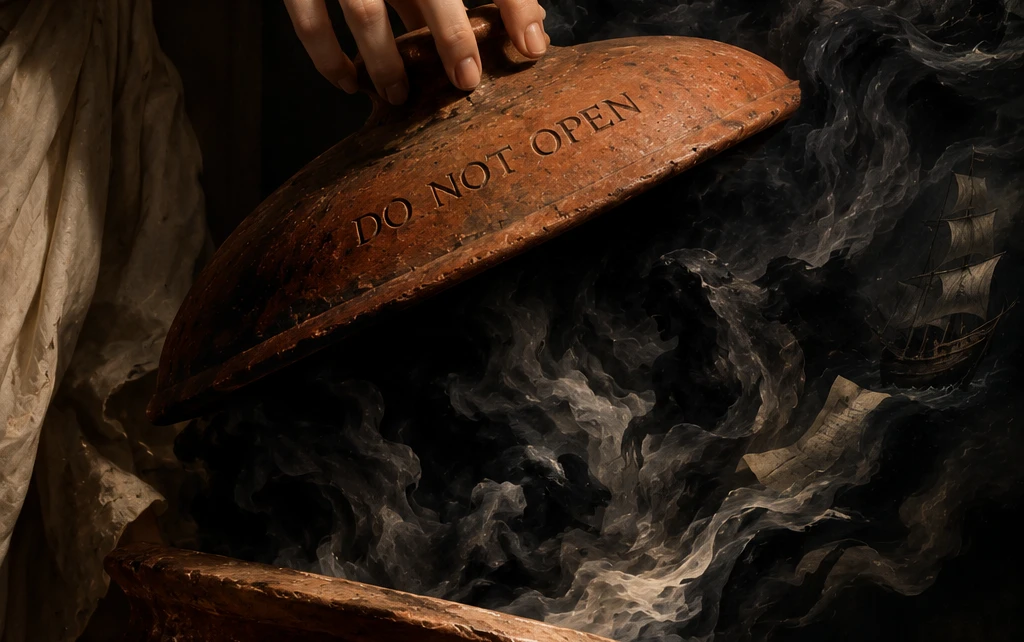
Pandora brings catastrophe, but not quite in the way schoolbooks tell it. In Hesiod’s version there is no “DO NOT OPEN” sign and no prohibition addressed to Pandora. The warning, if anything, was for Epimetheus: Prometheus had told him not to accept gifts from Zeus. Epimetheus, naturally, accepted the gift anyway.
Hesiod says in a few words that the woman lifts the great lid of the jar and scatters the evils it contained. Disease, toil and suffering spread through humankind. Only Hope (Elpis) remains inside, held back by the lid at Zeus’s command.10
The idea that Pandora broke an explicit prohibition out of curiosity is a later retelling. Hesiod does not explain why she opens the jar; her motive remains unknown.11 And, knowing Zeus, it is hard not to suspect that this was not exactly a selfless gift.
In Apuleius’s story of Love and Psyche, by contrast, both the prohibition and the curiosity are explicit. He tells it in his Metamorphoses12: to win back Cupid’s love, Psyche must complete four tasks set by Venus. The final task takes her to the Underworld: she must visit Proserpina and bring Venus a box containing some of Proserpina’s beauty.
The talking tower Psyche turns to before descending into the Underworld explains the route to the realm of the dead and gives her a precise warning: she must deliver the box to Venus without opening it or prying inside.13 Psyche survives the dangers of the Underworld and returns to earth with the box intact. A few steps from her goal, she gives in to temeraria curiositas. She thinks she can use a little of Proserpina’s beauty to look more beautiful to Cupid, and opens the box; instead, she finds infernal sleep and collapses as if dead. Only Cupid’s intervention saves her.14
5. A way to read the pattern – prohibition and breach
At this point, after bags, jars, lovers and other disasters, let us ask why so many stories revolve around a prohibition, a warning or the crossing of a boundary.
To read this pattern, it may help to set these stories alongside the pair of functions described by the Russian Formalist Vladimir Propp in Morphology of the Folktale15, in his analysis of wonder tales:
- The interdiction (function II): a character is given a prohibition, such as “Do not leave the house” or “Do not open the door.”
- The violation (function III): the prohibition is broken.
Here the pair works as a lens for some episodes, not as a universal law of storytelling. Propp notes that not every tale contains every function, and that a violation can occur without an explicit interdiction. The stories of Aeolus’s bag and Hesiod’s Pandora also show that a gesture capable of changing the course of a story does not always presuppose a ban: the crew act out of suspicion, while Hesiod does not say what drives Pandora to open the jar. If Orpheus did not turn around, he would leave Hades and the two would live happily ever after in three lines. If Odysseus’s crew did not open the bag, the voyage to Ithaca would not take that detour; if Pandora did not lift the lid, evils would not spread through humankind.
When it appears, a divine prohibition acts like a chemical reactor for storytelling. It is the sacred boundary separating the quiet, boring life of the obedient from the grand, painful, tragic and heroic adventure of human experience. By breaking the prohibition, people make mistakes, pay terrible prices and are punished by the gods, but at last become the true protagonists of their own fate.
There is often another constant in these stories: the protagonists have almost made it. Odysseus could already see Ithaca in the distance, Orpheus the light, Psyche the earth, and yet the rule is broken at that very moment. The closest analogy is an athlete leading the race who stumbles or stops just before the finish line. Mistake, distraction or choice? Perhaps we like to imagine tragic, romantic figures stopping to think: “Wait, no! I’m almost there. I’ve proved I can do it, but there’s a condition, a small and simple condition, maybe for my own good. I’m not doing it.”
Accepting the risk of curiosity
Next time you find yourself facing a “No smoking,” “Do not touch” or “Wet paint” sign and feel that tiny, perverse urge to reach out and check whether the paint really is wet, smile. You are not crazy. You are responding to humanity’s genetic, cultural and mythological inheritance: we have been willing to risk Zeus’s thunderbolts, Poseidon’s curses and the sleep of the Underworld just to find out what was inside the box.
We are the descendants of the sailors who untied Aeolus’s bag, the children of Pandora’s curiosity and the siblings of Orpheus’s doubt. Rules and warnings keep society running, but our glorious, disastrous acts of disobedience have filled the history books and turned our fragile species into the most fascinating poem ever written.
And I have not yet mentioned the famous fruit-related incident in the Near East: was that the first divine prohibition that came to mind?
Notes
- Homer, Odyssey, X, lines 19-45: Aeolus gives Odysseus the sealed bag, and the crew, suspecting it contains treasure, decide to open it. ↑
- Homer, Odyssey, X, lines 38-45. The crew’s speech reveals their suspicion that the bag contains riches. ↑
- Homer, Odyssey, XI and XII. Tiresias warns Odysseus in Book XI; Circe repeats the warning in Book XII. ↑
- Homer, Odyssey, XII, lines 340-351. Eurylochus’s speech about the Cattle of the Sun. ↑
- Homer, Odyssey, XII, lines 394-396. The portent of the hides and meat during the sacrifice. ↑
- Ovid, Metamorphoses, X, lines 40-44; Virgil, Georgics, IV, lines 481-484. ↑
- Ovid, Metamorphoses, X, lines 50-55. ↑
- Virgil, Georgics, IV, lines 485-493. ↑
- Ovid, Metamorphoses, X, lines 56-57. ↑
- Hesiod, Works and Days, lines 60-105, trans. Gregory Nagy: Hesiod, Works and Days – Center for Hellenic Studies. ↑
- William Hansen, Can interpretations of the Pandora myth tell us something about ourselves? – OUPblog. The article discusses Hesiod’s silence about Pandora’s motive. ↑
- Apuleius, Metamorphoses, books IV-VI. ↑
- Apuleius, Metamorphoses, VI, 16-20. ↑
- Apuleius, Metamorphoses, VI, 20-21. ↑
- Vladimir Propp, Morphology of the Folktale, first published in 1928, ch. III. Propp’s text (PDF). ↑