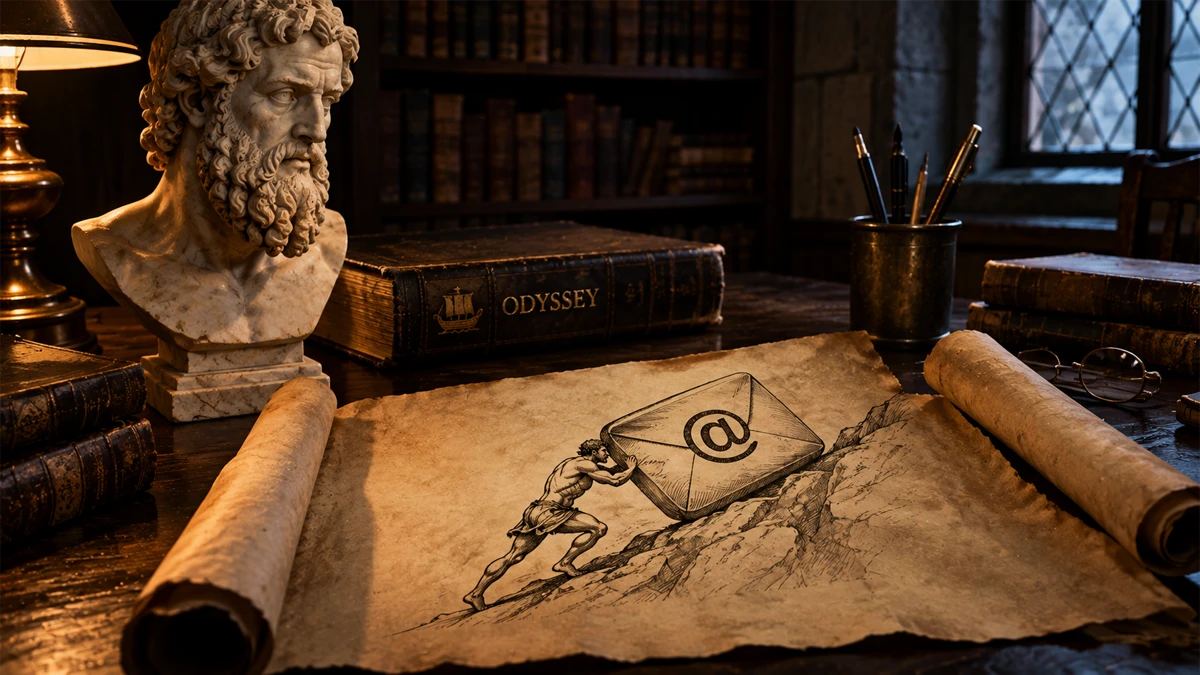
Do memes speak Greek? Open TikTok, scroll through X or lose yourself in the darkest corners of Reddit. Between a dancing cat and a street food review, sooner or later you run into him: a little stick-figure man pushing an enormous boulder up a steep mountainside, captioned “Me finishing answering all my work emails at 5:59 p.m., only to watch a new notification arrive at 6:00 p.m.”. In the background, the usual melancholy synthwave soundtrack and the legendary quote from Albert Camus: “One must imagine Sisyphus happy”.
Or you come across the cartoon in which the Trojan Horse carries on its flank the label “URGENT_INVOICE.pdf.exe”, with the celebrating Trojan citizens cast in the role of your rock-solid digital naïveté. Or again, hundreds of variations on Icarus “flying too close to the sun”, used to mock the boss of some cryptocurrency startup that went bust within twenty-four hours.
In the very midst of the era of artificial intelligence, predictive algorithms and quantum physics, the most pop and instant visual languages keep feeding heartily on the stories invented three thousand years ago by a handful of shepherds, blind singers and aristocrats of archaic Greece. Gen Z and Millennials, even without knowing by heart the difference between a Latin declension and a Greek aorist, use classical mythology as a universal dictionary of emotional reactivity.
The Greeks didn’t just invent democracy and philosophy: they invented the very infrastructure of the meme. Today we try to understand why Homer and Ovid were the greatest content creators in history, and why Greek myths will remain the inexhaustible source of every model of digital culture.
1. The philological definition of meme: the lesson of Richard Dawkins
The word meme was not born in the corridors of Silicon Valley. It was coined in 1976 by Richard Dawkins, an evolutionary biologist, in his fundamental work The Selfish Gene1.
Dawkins was looking for a word to define the minimal unit of cultural transmission, the cultural equivalent of the gene in biology or of the phoneme in linguistics. He wanted a term that would recall the Greek word mímesis2, which means “imitation”, “reproduction”, but that would be short and catchy like gene. Thus was born the term meme, with the same ambition as its model: to survive by copying itself.
A meme, then, is an idea, a behavior, a phrase or an image that propagates from mind to mind by way of imitation and variation. In practice, it goes viral. The strongest memes, exactly like the best-adapted genes, survive across the centuries because they possess three precise characteristics:
- Copy fidelity (they are easily recognizable and replicable);
- Fecundity (they spread rapidly in different contexts);
- Longevity (they resist the passing of time).
Greek myths are, in the strictest Dawkinsian sense, the most successful memes in the whole of human history. They are modular narratives, encoded in plastic and indelible images, born in the orality of the aedic tradition (think of the singers who repeated the Homeric formulas from fair to fair: the catchphrases of the era) in order to be continually read, modified, readapted and sampled by every generation. Classical mythology was the first open-source software of the human mind.
2. Sisyphus, the emblem of things to do all over again
Book XI of the Odyssey, when Odysseus descends into the Underworld, gives us one of the most anguished and physical descriptions of eternal punishment:
And I saw Sisyphus at his endless task raising his prodigious stone with both his hands. With hands and feet he tried to roll it up to the top of the hill, but always, just before he could roll it over on to the other side, its weight would be too much for him, and the pitiless stone would come thundering down again on to the plain. Then he would begin trying to push it up hill again, and the sweat ran off him and the steam rose from him.3
This king of Corinth, guilty of having cheated Death (Thanatos) and of having spilled Zeus’s secrets, has become the patron saint of contemporary memes because he visually represents the concept of systemic futility.
In the twentieth century, the existentialist philosopher Albert Camus, in his famous essay The Myth of Sisyphus4, promoted him to an image of the human condition: the hero of the Absurd, the modern man stuck in the alienating routine of office work and lack of meaning.
But internet culture has taken Sisyphus to a whole new level of pop. Today Sisyphus is the definitive meme of bureaucracy, of Roguelike video games (where you die and start over from scratch a thousand times) and of household management. Cleaning the kitchen only to see it dirty again the next day? That’s Sisyphus. Fixing a bug in the code only to watch three more sprout? That’s Sisyphus. Answering emails? That’s Sisyphus.
The meme works because it condenses a universal psychological frustration into a single dynamic image. You don’t need a lecture on the theory of the Absurd: the little man and the stone are enough. Whoever looks at the screen recognizes themselves in a millisecond, and laughs.
3. The Trojan Horse: the visual metaphor of the cyber trojan
If you turn to book II of Virgil’s Aeneid, you find yourself facing the chronicle of the greatest social engineering and phishing operation of antiquity. The Greeks pretend to set sail and leave on the beach a gigantic wooden horse and a defector with the right story: a votive offering to Athena to secure their return home.
The priest Laocoön sees it differently and shouts the famous phrase “Timeo Danaos et dona ferentes” (“I fear the Greeks even when they bring gifts”5), but nobody listens to him. The horse is dragged inside the walls amid great singing and celebration. That very night, the warriors come out of the belly of the wooden monster and open the gates of the city to the rest of the army.
The Trojan Horse is an inexhaustible meme factory because it is the perfect conceptual model of any threat disguised as a gift.
In the 1980s and 1990s, computer security literally borrowed the mythological term to define the malware that hides inside apparently innocuous programs (trojan viruses, precisely). Today, meme culture has widened the range of action:
- The psychological level: “Me deciding to go out for one quiet beer” is the horse; the second beer, the round of shots and the digestif “to settle the stomach” are the soldiers climbing out of the belly while the city lies buried in sleep and wine; the next day’s remorse enters at dawn with the rest of the army and finds the gates already open.
- The biological level: lactose intolerance lying in wait behind a delicious salted caramel ice cream.
- The social level: the cat that comes into the house from outside looking adorable, only to reveal itself as a destroyer of curtains and sofas.
The strength of the meme lies in its bipartite structure: a reassuring wrapper outside and a devastating content inside. Antiquity packaged the perfect aesthetic container; all we have to do is change the labels to adapt it to our daily neuroses.
4. Icarus and the hubris punished by the algorithm: flying too high to fall hard
Ovid, in book VIII of the Metamorphoses, tells of Daedalus, an engineer in a tight spot, and of his son Icarus, locked in the Cretan Labyrinth by King Minos. Daedalus, a true pioneer of technology, builds two pairs of wings using bird feathers and beeswax.
Before taking flight, the father gives his son a very precise technical instruction, which is a lesson in moderation (the classic mēden agan, “nothing in excess”, carved on the temple of Delphi):
My son, I caution you to keep the middle way, for if your pinions dip too low the waters may impede your flight; and if they soar too high the sun may scorch them.6
Icarus, blinded by the exhilaration of flight and by youthful presumption, ignores his father’s advice. He climbs higher and higher, toward the sun. The wax melts, the feathers come loose and the boy plunges into the Aegean, giving his name to that stretch of sea.
In modern culture, “flying too close to the sun” has become the go-to meme for the self-destructive parabola of the ego. Every time a public figure, an influencer or an arrogant entrepreneur overreaches and falls disastrously from grace over an ill-judged tweet or a reckless financial operation, the internet reacts by publishing images of Icarus falling with his wings in flames.
Icarus is the meme of hubris punished by the algorithm. He represents that exact moment when success goes to your head, you lose contact with reality and the gravity of life collects its debt with interest.
5. Aby Warburg and the formulas of human emotion
There is an even deeper philosophical and art-historical explanation for the dominion of mythology over our visual aesthetics. The German art historian Aby Warburg7 devoted his life to studying how the images of classical antiquity return cyclically in Renaissance and modern art.
Warburg coined the concept of the pathosformel (“pathos formula” or “emotional formula”). According to Warburg, the artists of antiquity invented astonishing bodily postures, gestures and faces capable of crystallizing an extreme human emotion: terror in the face of death, the pain of mourning, the ecstasy of love, blind rage.
These “emotional formulas” imprint themselves on humanity’s collective memory like brands seared in with a hot iron. And when a later culture needs to express that same emotion, it does not invent an image from scratch: it reactivates the ancient pathosformel.
A meme template is a pathosformel in digital and degraded format: compressed, repeatable, but with the same mechanism. A few examples from the catalog:
- The despair of the defeated warrior is the statue of Laocoön or the face of the Dying Gladiator;
- The narcissistic obsession and the trap of self-exposure is the myth of Narcissus8 gazing at his own reflection in the water until he dies, exactly as we gaze at ourselves in the glowing black screen of the smartphone;
- The curse of the one who sees the truth but is believed by no one is Cassandra, the Trojan prophetess condemned by Apollo, today become the meme of anyone who tries to warn users about an imminent disaster and gets mocked in the comments.
Classical myths survive in memes because they offer pre-warmed emotional schemes. Our minds recognize them in a millisecond because they are part of our basic cultural software.
This is why we should not look at mythological memes with condescension, as if they were a pop devaluation of high culture. On the contrary: the fact that a twenty-year-old can express his frustration over a university exam or a work shift using Sisyphus, the Trojan Horse or Medusa is proof that Greek mythology is alive, well and in excellent health.
Mythology as the ultimate meme of the human condition
The Greeks did not write stories to be conserved in museums or to be read only in university lecture halls. Myths were dynamic, elastic, theatrical material, destined to be transformed, parodied and rewritten by every tragedian, comedy writer or citizen with an idea.
Perhaps even Homer, seeing his stories turned into animated gifs, would smile with satisfaction from the Underworld, thinking that, when all is said and done, his metis has won one more time.
Notes
- Richard Dawkins, The Selfish Gene (1976); the theory of memetic transmission is set out in particular in chapter 11, devoted to memes. ↑
- The etymology is in the Online Etymology Dictionary: 1976, “introduced by evolutionary biologist Richard Dawkins in The Selfish Gene, coined by him from Greek sources, such as mimeisthai ‘to imitate’ …, and intended to echo gene” (etymonline.com). ↑
- Homer, Odyssey, book XI (the punishment of Sisyphus). The verses quoted are from the translation by Samuel Butler (1900; full text on Wikisource). ↑
- Albert Camus, The Myth of Sisyphus (1942); the English line is from the translation by Justin O’Brien (1955). ↑
- Virgil, Aeneid, II, v. 49; the English rendering is the traditional one. ↑
- Ovid, Metamorphoses, book VIII; the verses quoted are from the translation by Brookes More (1922). ↑
- Aby Warburg (1866-1929), Mnemosyne Atlas (Nino Aragno ed.). ↑
- Ovid, Metamorphoses, book III. ↑